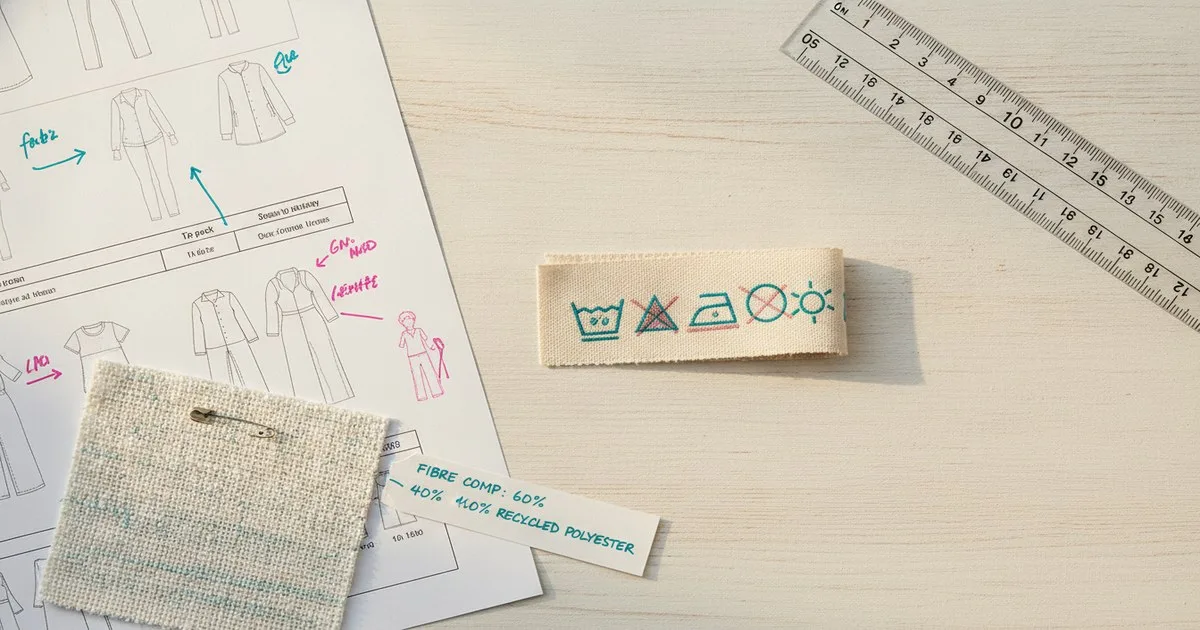
A care label callout that is missing one field — say, the fibre percentage or the market-specific regulatory reference — will stop a production run while the factory waits for clarification. Get the spec right in the tech pack and you cut that loop entirely.
Key takeaways
- Every care label callout needs at least five data fields: fibre content with percentages, country of origin, care symbols (with the standard they follow), language requirements per market, and label placement.
- ISO 3758 is the international baseline for care symbols, but the US, Canada, and Japan each layer additional requirements on top of it.
- Factories need the regulatory reference written into the spec — not assumed — so their compliance team can verify sourcing without contacting you.
- A single label callout block in your tech pack, structured consistently, is enough to cover multi-market production if you include a market column.
- Vague instructions such as 'standard wash' or 'as per sample' are the single most common cause of care label rejections.
What do you need before you start?
Before you open the label callout section of your tech pack, have these ready:
- Confirmed fabric composition from your mill, including all components (shell, lining, interlining, trim) with fibre percentages that add up to 100% per component.
- Confirmed destination markets — at minimum, know whether you are selling into the US, EU, UK, Canada, Japan, or Australia, because each has different mandatory fields.
- Lab test results or care instructions from your fabric supplier, which give you the safe wash, dry, and iron parameters for the actual fabric you are using.
- Your brand's label template or an approved label vendor, so you know the physical constraints: label width, number of lines, available colours.
- A copy of your tech pack open and ready — the care label callout lives inside the Bill of Materials / trims section, usually after the main label and hang tag entries.
If you do not yet have confirmed fibre percentages from the mill, do not estimate. A label that reads '60% cotton, 40% polyester' when the actual fabric tests at '58% cotton, 42% polyester' is a compliance failure in most markets.
Step 1: Fill in the fibre content field — every component, every percentage
List the fibre composition for each distinct component of the garment separately. The shell, the lining, and any interlining each get their own line. Write the dominant fibre first, then descending order by percentage. Use the standardised fibre names your destination market requires — the EU uses 'elastane', the US uses 'spandex' for the same fibre.
For a jacket with a shell and a lining, your entry might look like:
- Shell: 78% recycled polyester, 22% elastane
- Lining: 100% polyester
Expected result: the factory and the label printer have no ambiguity about what to print, and the percentages are traceable to your mill certificate.
If a component makes up less than the threshold your market sets (typically under 5% in the EU), you may be permitted to group it under 'other fibres' — but check the current regulation for each market before doing so, because thresholds differ.
Step 2: Add the country of origin
Country of origin on a care label is a legal requirement in the US (Federal Trade Commission rules), Canada (Competition Bureau rules), and several other markets. In the EU it is not currently mandatory on textile labels, but many brands include it voluntarily for customs and consumer transparency purposes.
In your tech pack spec, write the country of origin as a field with two possible states:
- Known at spec stage: write it directly — 'Made in Portugal'.
- Not yet confirmed: write 'Country of origin: TBC — factory to confirm and submit for approval before label order is placed.' Do not leave the field blank; a blank field gets skipped.
Expected result: the factory knows it is responsible for confirming and flagging this field before it orders labels, which prevents labels being printed with the wrong origin.
Step 3: Specify care symbols and the standard they follow
This is the field most specs get wrong. Do not write 'standard care symbols' or paste an image without a reference. Instead, specify:
- The symbol set: ISO 3758 is the international baseline and is used across the EU, UK, Australia, and most of Asia. The US and Canada accept ISO 3758 but also permit ASTM D5489 symbols — confirm which your label vendor supplies.
- Each symbol explicitly: list the five symbol categories in order — washing, bleaching, drying, ironing, professional textile care — and write the specific instruction for each. For example: 'Machine wash 30°C gentle cycle / Do not bleach / Tumble dry low / Iron medium heat / Do not dry clean.'
- The symbol source: reference the standard by name in the spec field, e.g. 'Care symbols per ISO 3758.'
If you are selling into Japan, note that Japan uses JIS L 0001, which has a different symbol set from ISO 3758. You will need a separate label or a label that carries both sets.
Expected result: the label printer selects the correct symbol artwork from their library, and your compliance team can verify against the named standard without asking you for clarification.
Never derive care instructions from a mood or a guess about the fabric. Use the wash test results from your fabric supplier or an accredited lab. If those results are not in hand, hold the label spec until they are.
Step 4: Set the language requirements per market
Care labels must be in a language the consumer can read. The minimum requirements by major market:
- US: English required.
- EU: the official language(s) of the member state(s) where the garment is sold. If you are distributing across multiple EU countries, you will need multiple languages on one label or separate labels per market.
- Canada: English and French (both mandatory under the Textile Labelling Act).
- UK: English (post-Brexit, UK rules mirror former EU requirements but are now set domestically).
- Japan: Japanese required for domestic sale.
In your tech pack, add a 'Markets and languages' column to the label callout table. List each market and the required language(s). If the label must carry more than two languages, flag this to your label vendor early — it affects label width and font size.
Expected result: the factory and label vendor know exactly which language versions to produce, and you avoid a last-minute reprint because the Canadian bilingual version was not specified.
Step 5: Specify label placement and attachment method
The compliance spec is only half the job. The factory also needs to know where the label sits and how it is attached, because placement affects consumer experience and, in some categories, safety.
In the same callout block, include:
- Position: e.g. 'Centre back neck, below main label' or 'Left side seam, 15 cm from hem.'
- Attachment: sewn-in (specify fold type — straight, mitre, or loop fold), heat-transfer, or printed-on.
- Label dimensions: width x height in millimetres, or reference your approved label vendor's standard size.
- Fold: if sewn-in, specify whether the label is folded in half (so the text reads on the outside) or left flat.
Expected result: the sewing room attaches the label in the correct position without a separate instruction sheet, and the QC team can check placement against the spec at inline inspection.
Step 6: Add the regulatory reference line
This is the field most production teams omit, and it is the one that saves the most time when a factory compliance team or a customs inspector asks for justification.
At the bottom of your care label callout block, add a single line:
'Regulatory references: US — FTC Care Labeling Rule (16 CFR Part 423); EU — Regulation (EU) No 1007/2011 on textile fibre names; Canada — Textile Labelling Act and Regulations; UK — UK Textile Products (Labelling and Fibre Composition) Regulations 2012; care symbols per ISO 3758.'
You do not need to reproduce the full regulation text. Naming the regulation is enough for a factory compliance officer or freight forwarder to pull the current version and verify.
Expected result: the factory can self-serve on compliance questions without routing every query back to you.
How does this fit into the broader tech pack?
The care label callout sits inside the trims and labels section of your tech pack, which is part of the Bill of Materials. A well-structured tech pack — as covered in guides from Techpacker and White Label Manufacturing — treats every trim as a line item with supplier, colour, size, placement, and compliance notes. The care label is no different: it is a trim with regulatory consequences.
If you use a template bundle (such as those available on platforms like Etsy), check that the label callout section includes all six fields above. Many templates include fibre content and care symbols but omit the regulatory reference line and the market-language column — add those fields before you send to factory.
For visual development earlier in the process, tools like NewArc let you upload a sketch and experiment with materials and colourways before the spec is locked, which can reduce late-stage changes that ripple into label updates. Adobe Firefly is useful for generating reference imagery during the design phase. Neither replaces the compliance spec itself, but both can reduce the number of design iterations that force you to revisit your label content.
Our overview of Techpacker as a production tool goes deeper on how software-managed tech packs handle label callouts and revision history — worth reading if you are managing multi-market compliance across a large range.
Troubleshooting: common care label spec problems
The factory printed the wrong fibre percentage. Cause: the spec was written before the mill certificate arrived and was never updated. Fix: add a 'Do not order labels until mill certificate is received and fibre content is confirmed' note to the label callout block. Make this a standard step in your critical path.
The care symbols on the finished label do not match the spec. Cause: the label vendor used a different symbol version (e.g. older ISO 3758 artwork). Fix: specify in the callout that the vendor must use the current edition of ISO 3758 and submit a digital proof for approval before printing.
The Canadian market label is missing the French text. Cause: the market-language column was not in the spec, so the factory produced one version. Fix: add the market column to every label callout as a non-optional field, and flag bilingual requirements at the top of the callout in bold.
Customs holds the shipment because country of origin is missing. Cause: the field was left as 'TBC' and the factory assumed it was optional. Fix: make country of origin a mandatory approval step before the label order is released — add it to your pre-production checklist.
The label is too wide for the garment neckline. Cause: multiple languages and symbols were added without checking label dimensions. Fix: get a physical or digital proof from the label vendor before approving the spec, and include maximum label width in the callout.
What does a complete care label callout look like?
A finished callout block in your tech pack should answer all of these without the factory needing to ask:
- What fibres, in what percentages, for which component?
- Where was it made?
- What are the safe care instructions, and which symbol standard applies?
- Which languages are required, for which markets?
- Where does the label sit, and how is it attached?
- Which regulations govern this label?
If you can tick all six, the factory can source, print, and attach the label without a single email back to your team.
FAQ
What is the difference between ISO 3758 and ASTM D5489 for care symbols? ISO 3758 is the international standard used in the EU, UK, Australia, and most of Asia. ASTM D5489 is the US standard. The symbols are similar but not identical. Most US label vendors carry both; specify which set you need in the callout.
Do I need a separate label for each market? Not necessarily. A single label can carry multiple languages and both ISO and JIS symbol sets if space allows. Check with your label vendor on maximum line counts and minimum font sizes before deciding.
Can I use 'as per approved sample' instead of listing care instructions? No. 'As per approved sample' is not a compliant instruction for a care label spec. The factory needs explicit, written care instructions that can be verified against a standard. Samples get lost; written specs do not.
What happens if fibre content on the label does not match the lab test? In most markets, a mismatch between the declared fibre content and the tested fibre content is a regulatory violation that can result in product recalls, fines, or import refusals. Always base the label content on the mill certificate and, where required, an independent lab test.
Where in the tech pack does the care label callout go? It belongs in the trims and labels section, within the Bill of Materials. List it as a line item alongside the main label, hang tag, and any other sewn-in labels, with the same level of detail for each.