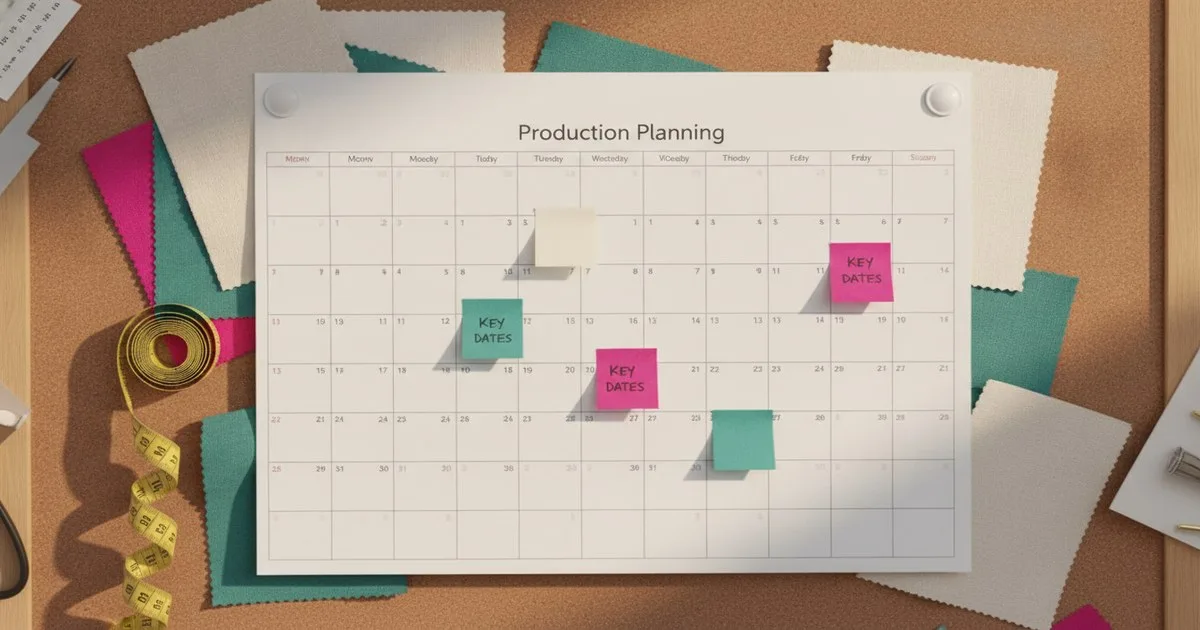
A production calendar is not a wish list of dates — it is a chain of dependencies, and one broken link ripples through every milestone that follows. Start by anchoring your delivery date, then work backwards through bulk production, quality assurance, sample rounds, and fabric lead times. That reverse-engineering exercise is where schedule risks surface, while you still have room to act on them.
Key takeaways
- Build your calendar backwards from the confirmed in-store or warehouse delivery date, not forwards from the design brief.
- Fabric and trim lead times are the longest single variable in the chain; secure them before any other milestone is set.
- Each sample round — proto, fit, pre-production — carries its own approval window; skipping or compressing one rarely saves time overall.
- A realistic critical path for a new style, including fabric sourcing, typically runs far longer than most brand teams initially budget.
- Document every milestone in a shared system so design, production, and factory contacts are reading the same calendar.
Why do so many production calendars fail?
The most common failure is building the calendar forward from the brief rather than backwards from delivery. When you plan forward, optimism compounds at every stage — you assume the fastest fabric lead time, the fewest sample iterations, and a factory with open capacity. By the time reality arrives, you have no buffer left.
A second failure is treating the calendar as a design team document rather than a production document. Dates that live only in a creative director's inbox do not protect a production coordinator. Every milestone needs an owner, a due date, and a consequence if it slips.
The third failure is underestimating lead times at source. Clothing production timelines from factory to final delivery can run sixteen to twenty-four weeks for a full production cycle — a figure many brands discover only after their first missed launch window.
What is a critical path in fashion production?
The critical path is the sequence of tasks where any delay directly delays your delivery date. It is not every task on your calendar — it is the longest chain of dependent tasks with no slack. In apparel, the critical path almost always runs through:
- Fabric and trim development and approval
- Proto sample construction and review
- Fit sample iteration
- Pre-production (PP) sample sign-off
- Bulk fabric cut and sew
- In-line and final quality inspection
- Packing, documentation, and shipment
Tasks that sit off the critical path — marketing photography, e-commerce copy, retail VM — can slip without affecting delivery. Tasks on it cannot.
Production scheduling is the discipline of sequencing these tasks, assigning resources, and monitoring progress against the baseline. For apparel, that baseline must account for factory minimums, inspection lead times, and shipping transit — not just sewing hours.
How do you build a production calendar backwards from delivery?
What you need before you start
- Confirmed delivery date (warehouse or retail floor, not ship date)
- Factory name and confirmed capacity window
- Fabric and trim supplier list with quoted lead times
- Number of styles and colourways in the range
- Sample approval process: who signs off, and how many rounds are budgeted
Step 1 — Anchor the delivery date
Write the delivery date at the far right of your timeline. Everything else is calculated left from here. If you have multiple delivery drops, create a separate critical path for each.
Step 2 — Subtract shipping and customs transit
Work backwards from delivery to get your ex-factory date. Add the transit time for your shipping mode (sea freight is typically three to five weeks for intercontinental routes; air is faster but the cost is rarely budgeted). Add customs clearance and inland transport. The result is your latest acceptable ex-factory date.
Step 3 — Subtract bulk production time
Ask your factory for a realistic cut-to-pack lead time for your specific product category. Wovens, knitwear, and outerwear each have different construction times. Add in-line quality checks and final inspection. Mark the date by which bulk fabric must be at the factory — that is your fabric delivery deadline.
Step 4 — Subtract fabric and trim lead time
This is the step most brands get wrong. Fabric development (lab dips, strike-offs, bulk approval) and trim development (label, hardware, zipper colour matching) run in parallel but both must be complete before the factory can cut. FW26 planning guides consistently flag fabric approval as the most common cause of bulk delays, particularly for heavier fabrics with longer dyeing cycles.
Count backwards from your fabric delivery deadline by the quoted lead time. That date is when you must place your fabric order — which means your fabric must be selected and approved before that.
Step 5 — Map your sample rounds
Working further left, slot in your sample rounds:
- Pre-production (PP) sample — made in bulk fabric and trims; must be approved before cutting begins. Allow time for the factory to make it, ship it, and for your team to review and return comments.
- Fit sample — often in development fabric; may require one or two rounds. Each round is a two- to four-week loop depending on factory location.
- Proto sample — first physical interpretation of the tech pack. Expect comments; rarely approved first time.
Between each sample round, build in an internal review window — at minimum three to five working days for comments to be consolidated and a clear approval or revision brief to be sent back.
Step 6 — Set the tech pack deadline
The factory cannot start a proto without a complete tech pack. A tech pack includes construction drawings, a bill of materials (BOM), measurement specs, and any special finishing instructions. A complete tech pack reduces back-and-forth and minimises the risk of a proto that misses the brief entirely. Your tech pack sign-off date is therefore the first hard milestone on the calendar — everything else depends on it.
Step 7 — Add the design brief
Finally, place the design brief at the start of the timeline. The gap between brief and tech pack sign-off is your design and development window. If that gap looks short, it usually means the delivery date needs to move — or the number of styles needs to shrink.
What are the most common milestone risks?
Fabric late approval
Lab dips that do not match, strike-offs that need re-runs, and bulk that arrives off-shade from approved samples are the leading causes of bulk delays. Mitigate by running fabric development in parallel with early sample rounds, not sequentially.
Sample comment consolidation
When comments from multiple stakeholders arrive at the factory in separate emails over several days, the factory cannot act until the last one arrives. Assign one person to consolidate all comments into a single, numbered revision brief before anything is sent.
Factory capacity conflicts
A factory that confirms your dates in week one may have taken on another client by week four. Confirm capacity in writing, and check in at each milestone — not just at the start.
Customs and documentation delays
Missing certificates of origin, incorrect HS codes, or late compliance documentation can hold a shipment at port for days. Build document preparation into the calendar as a named task with an owner, not an afterthought.
How do you keep the calendar visible and actionable?
A production calendar that lives in a spreadsheet on one person's desktop is not a production calendar — it is a personal to-do list. The milestone dates need to be visible to everyone who can affect them: design, sourcing, the factory contact, and QA.
PLM platforms designed for fashion teams make this significantly easier. BeProduct offers sample tracking, visual workflow boards, and real-time collaboration tools that let production coordinators share milestone status across design and factory contacts without relying on email threads. When a sample is approved or a date changes, everyone on the workflow sees it immediately.
For teams not yet using a PLM, a shared cloud spreadsheet with colour-coded status columns and a named owner for each row is a workable starting point — provided someone is responsible for keeping it current.
What does a realistic milestone table look like?
The table below shows a simplified critical path for a single style with a confirmed delivery date. Adjust the durations for your product category, factory location, and shipping mode.
| Milestone | Working backwards from delivery | Owner |
|---|---|---|
| Delivery to warehouse | Day 0 (anchor) | Logistics |
| Ex-factory / ship date | Minus transit + customs | Logistics |
| Final QA inspection passed | Before ex-factory | QA |
| Bulk cut and sew complete | Before inspection | Factory |
| Bulk fabric at factory | Before cut date | Sourcing |
| Fabric order placed | Minus fabric lead time | Sourcing |
| PP sample approved | Before fabric order | Production |
| PP sample reviewed internally | Before PP approval | Production |
| PP sample received | Before internal review | Factory |
| Fit sample approved | Before PP sample made | Production |
| Proto approved | Before fit sample | Production |
| Tech pack signed off | Before proto | Design + Production |
| Design brief issued | Start of timeline | Design |
Each row should carry a calendar date, not just a relative offset, once your delivery date is confirmed.
What is still unsolved in production calendar management?
Even well-structured calendars have blind spots. Real-time visibility into factory capacity is still largely relationship-dependent — most brands find out a factory is overloaded when a sample is late, not when the capacity conflict first appears. Shared digital calendars between brands and factories remain rare outside of large enterprise relationships.
Comment consolidation is another persistent gap. The tools exist to centralise feedback, but the habit of emailing the factory directly — bypassing the shared system — is hard to break without clear team protocols.
Finally, costing and calendar are often managed in separate tools, which means a schedule change that requires a fabric substitution does not automatically trigger a cost review. Connecting the BOM to the milestone calendar — so that a fabric swap flags a cost impact — is something platforms like BeProduct are working towards, and it remains an area where the industry has more ground to cover.
Industry observers, including reporting from The Business of Fashion, have noted that supply chain visibility and digital collaboration between brands and their factory partners continue to be priorities for the sector — and the production calendar is where that gap is most acutely felt by the people doing the work.
FAQ
How far in advance should I start building a production calendar? For a full production cycle including fabric development and multiple sample rounds, start building the calendar at least six months before your target delivery date. Complex categories — outerwear, structured tailoring, technical fabrics — may need longer.
What is the difference between a production calendar and a critical path? A production calendar lists all tasks and dates across a range or season. The critical path is the specific sequence of dependent tasks where any delay pushes the delivery date. Every calendar has a critical path inside it; not every task is on it.
How many sample rounds should I budget for? Budget for at least three rounds — proto, fit, and pre-production — for a new style. Carry-over styles with minor changes may need only a fit and PP round. Building in a contingency round is good practice if your delivery window has no flex.
What happens if my fabric lead time is longer than my calendar allows? You have three options: move the delivery date, select a fabric with a shorter lead time, or place a fabric commitment earlier — before the design is fully finalised. The third option carries risk if the design changes, so weigh it carefully.
How do I communicate a milestone slip to stakeholders without causing panic? Report the slip as soon as you identify it, with the downstream impact already calculated. Show which milestones are affected, what the revised dates are, and what action is being taken. A slip reported early with a recovery plan is manageable; one reported at the last minute rarely is.
Further reading
- FW26 Apparel Planning: Production Calendar Checklist
- Clothing Production Lead Times in Portugal
- Production Scheduling Basics
- The Ultimate Guide to Tech Packs in Clothing