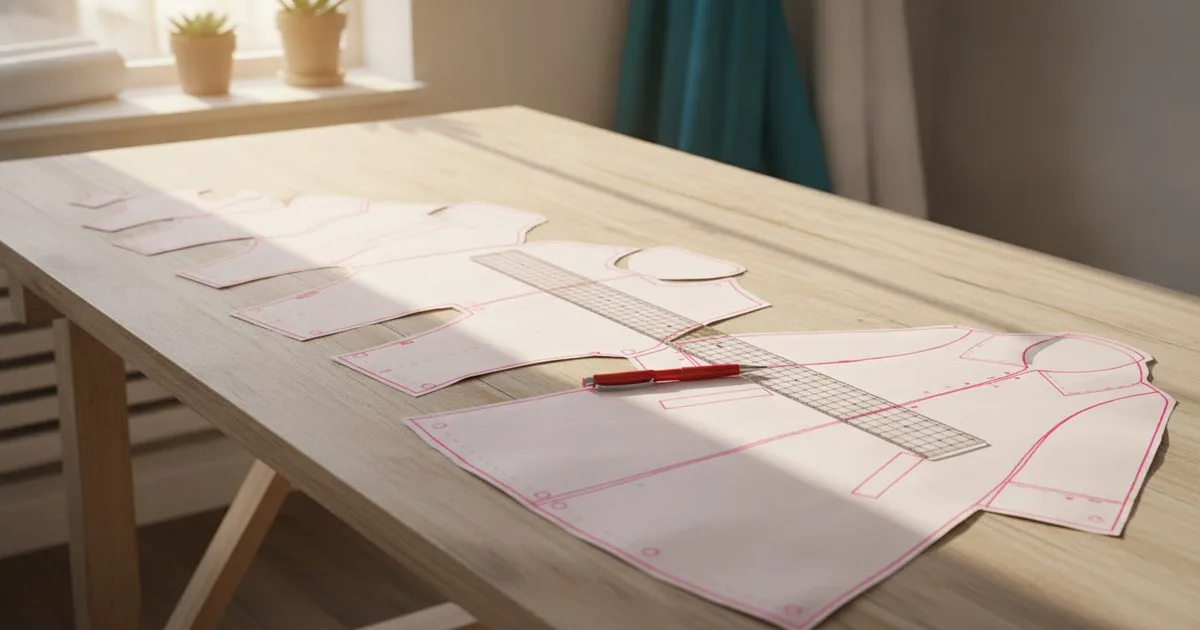
Your base size fits. Your grading rules look correct. And then the size XXS comes back from the factory with a chest that is too tight and a sleeve that pulls at the back, while the XXL swims around the shoulder. The garment did not change — the tolerances did. Tolerance stacking is the mechanism behind a large share of fit failures that only appear at size extremes, and it is almost always invisible until a fit session or a returns spike makes it undeniable.
Key takeaways
- Tolerances that are acceptable at a single grade step multiply across every step between your base size and your size extremes, so a ±1 cm chest tolerance can become a ±4 cm or ±5 cm swing by the time you reach the ends of your size run.
- The spec sheet is where you stop this: inter-grade tolerances must be tighter than single-measurement tolerances, and they must be written down explicitly.
- Fit failures caused by stacking are not random — they follow a predictable direction (always too small on the small end, always too large on the large end) which makes them diagnosable before bulk if you check cumulative deviation, not just point-to-point deviation.
- Body scanning and digital body data tools can expose the gap between your grade increments and the actual body measurements of your customers, giving you evidence to justify tighter tolerances to a factory.
- Catching stacking in the spec stage costs almost nothing; catching it after bulk production is expensive.
What is tolerance stacking, and why does grading make it worse?
Every measurement on a spec sheet carries a tolerance — the acceptable deviation above or below the target. A chest measurement of 96 cm with a ±1 cm tolerance means the factory can deliver anything from 95 cm to 97 cm and pass QC. That is reasonable for a single size.
Grading adds a new problem. When you grade up or down from a base size, each size inherits its own tolerance window. If your grade increment for the chest is 4 cm per size and your tolerance is ±1 cm, the actual delivered chest at any given size can sit anywhere within a 2 cm window. Across four grade steps — say, from a size M base to a size 3XL — those windows do not cancel each other out. They accumulate.
In the worst case, every size in the run sits at the outer edge of its tolerance in the same direction. A factory that consistently cuts slightly large (common when markers are optimised for fabric efficiency) will produce a size M that is 1 cm over, a size L that is 1 cm over its target, and so on. By the time you reach 3XL, the cumulative chest can be 4 cm to 5 cm wider than your design intent — even though every individual size passed its own QC check.
This is tolerance stacking: the compounding of individual measurement deviations across a sequence of grade steps.
Which measurements stack the worst?
Not all measurements are equally vulnerable. The ones that stack most destructively are those that:
- Have large grade increments relative to the tolerance window
- Affect multiple fit zones simultaneously (chest, for example, also affects armhole depth and side seam length)
- Are graded in the same direction at every step with no compensating measurement
Chest and bust are the classic culprits because the grade increment is large and the measurement governs how the entire bodice sits. Shoulder width stacks badly in tailored categories because a small cumulative error shifts the entire sleeve forward or backward. Sleeve length and inseam stack predictably in long runs because the increment is consistent and the tolerance is rarely tightened for extreme sizes.
Neckline width and depth are often overlooked. A neckline that is 0.5 cm too wide at base size may be 2 cm too wide at the largest size, turning a fitted crew neck into something that slips off the shoulder.
How to read cumulative deviation in your spec sheet
Most spec sheets record point-to-point measurements: what the target is for each size, and what the tolerance is. They do not record cumulative deviation — the total possible swing from the smallest to the largest size.
Add a cumulative deviation column. For each key measurement, calculate:
- The maximum possible value at the largest size (target + tolerance at every step above base, summed)
- The minimum possible value at the smallest size (target minus tolerance at every step below base, summed)
- The total swing: maximum minus minimum
If that swing is wider than the fit range your design can absorb, you have a stacking problem waiting to happen.
A chest with a 4 cm grade increment and a ±1 cm tolerance across five sizes above and below base has a theoretical cumulative swing of 12 cm. If your design works across a 6 cm chest variation, you will get fit failures at the extremes even with a perfect base size.
How to set inter-grade tolerances that actually control stacking
The fix is to write tighter tolerances for size extremes directly into your spec sheet. Here is a practical approach:
Step 1 — Identify your critical measurements. List every measurement that affects primary fit zones: chest, waist, hip, shoulder, sleeve length, inseam, neckline. These get tighter tolerances. Secondary measurements (hem width, pocket placement) can keep standard tolerances.
Step 2 — Calculate your acceptable cumulative swing. For each critical measurement, decide the maximum total variation the garment can absorb across the full size run. This is a design decision, not a factory decision — make it before you send the spec.
Step 3 — Back-calculate the per-step tolerance. Divide your acceptable cumulative swing by the number of grade steps in your run. If you have six sizes and can absorb 3 cm of total chest variation, your per-step tolerance is 0.5 cm — not 1 cm.
Step 4 — Write size-specific tolerances into the spec. Do not use a single tolerance column for all sizes. Add a tolerance column per size, or at minimum flag tighter tolerances for the two or three sizes at each extreme. Make it explicit: 'Size XS chest: ±0.5 cm. Size XL chest: ±0.5 cm. Sizes S–L: ±1 cm.'
Step 5 — Communicate the reason to your factory. Factories are more likely to respect a tighter tolerance when they understand why it exists. A brief note in the spec — 'cumulative grade deviation control' — signals that you have done the calculation and the tolerance is not arbitrary.
Step 6 — Measure size extremes first in your fit sessions. When you receive a fit sample set, measure and fit the smallest and largest sizes before you touch the base size. If stacking is happening, you will see it immediately rather than discovering it after approving the run.
Where body data tools fit into this workflow
One of the reasons tolerance stacking causes so many fit failures is that grade increments are often based on historical size charts rather than the actual body measurements of the brand's current customers. If your grade step assumes a 4 cm chest increment between sizes but your customer population shows a 5 cm average increment in that range, your tolerances are already misaligned before stacking compounds the problem.
Bold Metrics builds digital twins from consumer body data, mapping more than 50 body measurements per shopper. Brands using that data can compare their grade increments against the actual distribution of their customer bodies — a direct way to spot where the grade is too coarse or too fine for the population it is supposed to serve.
3DLOOK takes a different approach, extracting more than 80 body measurements from two smartphone photos. For brands that want to validate their grade at the size extremes, that kind of measurement data — collected from real customers at real sizes — can reveal whether a size XXS or XXL is genuinely being served by the current grading, or whether the cumulative tolerance swing has pushed those sizes outside the range of the bodies they are meant to fit.
Neither tool replaces the spec-sheet discipline described above. But they give you the evidence base to justify tighter tolerances to a factory, and to prioritise which measurements to tighten first.
What still does not have a clean solution
Tolerance stacking is well understood in principle but under-addressed in practice for a few reasons that are worth naming.
First, most QC systems check individual sizes against individual targets. Cumulative deviation is not a standard QC metric in most factory auditing frameworks. Until it is, the responsibility sits with the brand's tech pack, not the factory's QC process.
Second, tighter tolerances at size extremes increase cutting complexity and can reduce fabric efficiency in marker making. Factories will sometimes push back, and without a clear contractual basis in the spec, the tighter tolerance loses. Writing it into the spec — and into the purchase order — is the only reliable way to hold it.
Third, grading is still largely done by rule rather than by body data. Rule-based grading propagates the same increment uniformly across the size run, which is efficient but does not account for the non-linear way human bodies scale. As our guide to production-facing AI tools notes, the gap between rule-based grading and body-data-informed grading is one of the more consequential open problems in apparel production today.
A note on spec sheet templates
If your current spec sheet template does not have a cumulative deviation column or size-specific tolerance fields, it is worth rebuilding that section. Platforms like Kittl offer starting-point tech pack templates that you can adapt — the key is to add the tolerance architecture described above rather than relying on a single global tolerance figure.
The spec sheet is the contract between your design intent and the factory's output. If it does not capture cumulative tolerance logic, it cannot enforce it.
FAQ
What is tolerance stacking in apparel grading?
Tolerance stacking is the accumulation of individual measurement tolerances across multiple grade steps. A ±1 cm tolerance that is acceptable at one size compounds across every size in the run, so the total possible deviation at a size extreme can be several times larger than the single-step tolerance suggests.
Why does my base size fit but the size extremes fail?
Because tolerances are checked per size, not cumulatively. A factory can pass QC at every size individually while the cumulative deviation across the full grade run exceeds what the design can absorb. The base size sits in the middle of the run where stacking has not yet accumulated.
How do I calculate cumulative deviation for a measurement?
Sum the maximum possible deviation (tolerance) at each grade step above and below your base size. If you have five grade steps with a ±1 cm tolerance each, the theoretical cumulative swing is 10 cm. Compare that to the fit range your design can absorb and tighten per-step tolerances accordingly.
Should I use the same tolerance for all sizes?
No. Size extremes should carry tighter tolerances than mid-run sizes, because they are furthest from the base and have accumulated the most deviation. Write size-specific tolerances into your spec sheet explicitly.
How can body data help with tolerance stacking?
Body data from tools that map real customer measurements lets you check whether your grade increments match the actual distribution of your customer population. If your increment is too coarse or too fine for a given size range, your tolerances are misaligned before stacking even begins.
At what point in the process should I check for stacking?
During spec writing, before you send to the factory. Calculate cumulative deviation for every critical measurement as part of building the spec. Then verify by measuring size extremes first — before the base size — in every fit session.