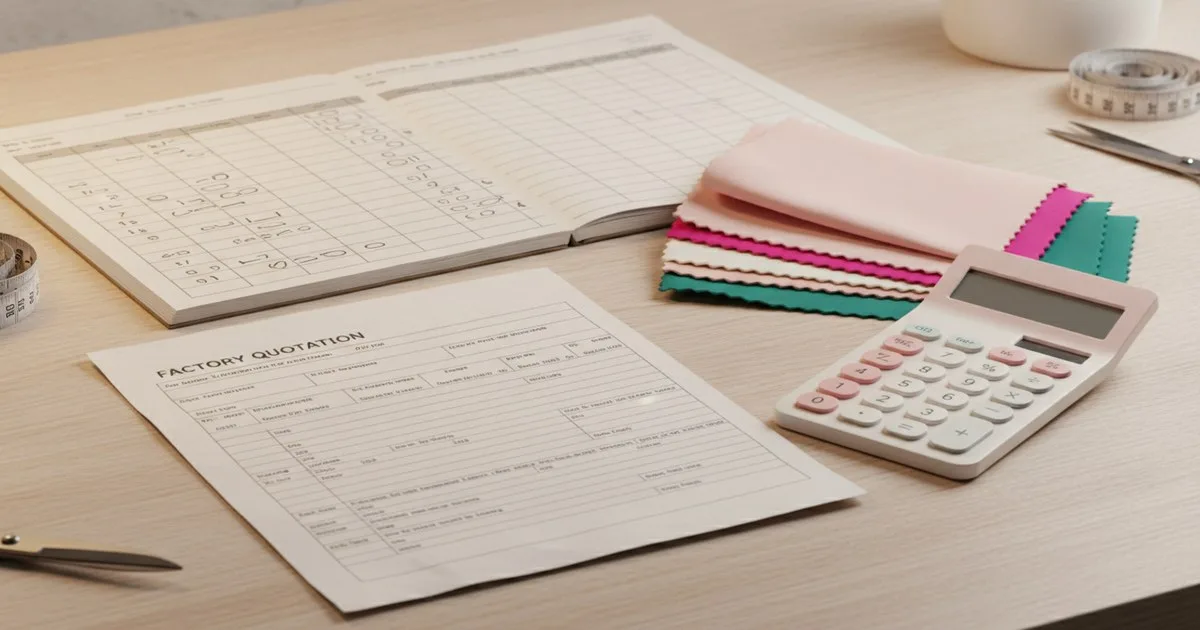
When you send a request for quotation to three factories and get three numbers back, those numbers are almost certainly not measuring the same thing. One quote might cover only the labour of cutting, making, and trimming. Another might include fabric, trims, and shipping to port. A third might land the finished goods at your warehouse door, duties paid. Comparing them at face value is one of the most common — and most expensive — mistakes in production coordination.
This guide explains what each pricing model actually includes, where risk and cost transfer from factory to buyer, and how to build a comparison that puts every quote on the same footing.
Key takeaways
- CMT is a labour-only model: the buyer owns and supplies the fabric, so fabric risk sits entirely with your team.
- FOB transfers risk at the port of export; everything from that point — freight, insurance, import duties — is the buyer's problem.
- DDP is the closest thing to a total landed cost: the seller handles export, freight, and import clearance, delivering to your door.
- A like-for-like comparison requires you to add the missing cost layers to every quote before you can rank them.
- Your PLM or costing tool is the right place to store these layered costs so the full picture travels with the tech pack.
What does CMT mean, and what does it include?
CMT stands for Cut, Make, Trim. The factory is selling you labour and the use of its equipment. You, the buyer, supply:
- All fabric (already sourced, tested, and shipped to the factory)
- All trims and findings (zips, buttons, labels, elastic, thread)
- The tech pack, patterns, and approved samples
The factory cuts your fabric to your patterns, assembles the garment, and attaches your trims. That's it.
What CMT does not include
- Fabric cost or fabric risk (if the roll is defective, that's your loss)
- Trim procurement
- Shipping from the factory
- Any import or export duties
- Quality inspection (unless separately contracted)
When CMT makes sense
CMT works well when you have an established fabric supplier relationship, when you need tight control over material quality, or when you're working with a factory that specialises in a particular construction technique but doesn't have a sourcing arm. Brands with strong in-house sourcing teams often prefer it for exactly this reason.
The downside is operational load. You are managing two supply chains — materials and manufacturing — in parallel. A delay in fabric delivery is your delay, not the factory's problem.
What a CMT quote looks like
A CMT price is typically expressed per unit (per piece) and broken down by operation: cutting, fusing, assembly, finishing, pressing. A well-structured tech pack with accurate operation breakdowns makes it much easier to audit whether a CMT quote is realistic. If the factory's minute values don't match your operation sequence, the price will drift in production.
What does FOB mean, and where does risk transfer?
FOB stands for Free On Board. Under this model, the factory (or its nominated freight forwarder) is responsible for the goods until they are loaded onto the vessel at the named port of export. The moment the goods cross the ship's rail, risk and cost transfer to you.
A FOB price typically includes:
- Fabric and trims (sourced by the factory)
- Cut, make, and finish
- Inland transport to the export port
- Export customs clearance and export duties
- Loading onto the vessel
It does not include:
- Ocean or air freight
- Marine insurance
- Import customs clearance at your destination
- Import duties and taxes
- Inland delivery from your port to your warehouse
FOB is the most common pricing model in international garment sourcing, and it's the baseline most freight forwarders and logistics teams are set up to work with. The Incoterms® 2020 rules published by the International Chamber of Commerce define the exact obligations, costs, and risk transfer points for FOB and all other trade terms — worth having on hand when you're reviewing factory contracts.
The hidden costs buyers forget to add
When you receive a FOB quote, you still need to account for:
- Ocean freight (per CBM or per container, depending on volume)
- Destination port charges (terminal handling, documentation)
- Import duties (tariff rate × FOB value, in most duty calculation methods)
- Customs brokerage fees
- Inland delivery to your DC or warehouse
These costs can add 15–30% on top of the FOB price depending on the trade lane, tariff classification, and your destination country. If you're comparing a CMT quote from a factory you supply directly against a FOB quote from another factory, you need to add your fabric and trim cost to the CMT number before you can compare them.
What does DDP mean, and is it really landed cost?
DDP stands for Delivered Duty Paid. It is the most seller-friendly Incoterms rule from the buyer's operational perspective: the seller delivers the goods to the buyer's named premises, clears export and import customs, and pays all duties and taxes along the way.
As the ICC Academy explains, under DDP the seller fulfils their delivery obligation when the goods are at the buyer's disposal at the agreed destination, ready for unloading — with all export, transit, and import clearance formalities handled and paid by the seller.
A DDP price includes, in principle:
- Everything in a FOB price
- Ocean or air freight
- Marine insurance
- Import customs clearance
- Import duties and taxes
- Inland delivery to your named destination
Why DDP quotes are not always what they seem
DDP sounds like a single, clean number — and sometimes it is. But watch for these common issues:
- Duty estimation risk: The factory or its freight partner may have estimated duties based on an incorrect HS code. If the actual duty rate is higher, someone has to absorb the difference — and the contract language will tell you who.
- Insurance gaps: Check whether marine insurance is included and at what coverage level.
- Last-mile scope: "Delivered to your premises" needs a specific address in the contract. A DDP quote to "the port of Los Angeles" is not a DDP quote in the Incoterms sense.
- Hidden margin: Factories that offer DDP are essentially acting as freight forwarders and will price that service accordingly. You may be paying a premium for convenience.
DDP is often the right choice for smaller brands that don't have in-house logistics teams, or for new trade lanes where you haven't yet established freight relationships. For high-volume buyers with dedicated logistics operations, FOB usually gives you more control and often lower total cost.
How to build a like-for-like comparison
This is where most production teams lose time. You have a CMT quote, a FOB quote, and a DDP quote from three different factories. Here's a structured way to normalise them.
What you need before you start
- Your fabric cost per metre and your yield per unit (from your BOM)
- Your trim cost per unit (from your BOM)
- Current freight rates for your trade lane (from your freight forwarder)
- The applicable duty rate for your HS code at your destination
- Any known port or brokerage fees
Step 1 — Establish your target: total landed cost per unit
Decide on a single destination point — typically your warehouse or DC — and work backwards. Every quote needs to arrive at the same destination with the same scope.
Step 2 — Layer the CMT quote
CMT unit price
+ Fabric cost per unit (metres × cost per metre)
+ Trim cost per unit
+ Freight to factory (if you're shipping materials)
+ Outbound freight (factory port → your warehouse)
+ Import duty
+ Customs brokerage
= CMT landed cost per unit
Step 3 — Layer the FOB quote
FOB unit price
+ Outbound freight (named port → your warehouse)
+ Import duty
+ Customs brokerage
+ Port/terminal charges
= FOB landed cost per unit
Step 4 — Verify the DDP quote
DDP unit price
− Any costs NOT actually included (check the contract)
+ Any gap costs you've identified
= DDP verified landed cost per unit
Step 5 — Add quality and lead-time risk
Cost is not the only variable. A factory with a lower landed cost but a 20% defect rate in your last order is not cheaper. Add a column to your comparison for:
- Historical defect rate (from your QC records)
- Lead time reliability
- Minimum order quantity
- Payment terms
Where your BOM and PLM fit into this
The comparison above only works if your BOM is accurate and up to date. A bill of materials that carries current fabric costs, trim costs, and yield figures is the foundation of any costing exercise — whether you're normalising quotes or tracking actuals against budget.
A well-structured BOM functions as a living document that feeds both sourcing and costing, meaning the same data that drives your CMT calculation also informs your FOB comparison. Keeping development costing and actual landed cost on the same record — rather than in separate spreadsheets — is what makes that comparison reliable at scale.
PLM platforms are the natural home for this data. WFX is a digital commerce services platform used by production teams to manage supplier relationships, costing, and workflow alongside their product data. Centric PLM, part of Dassault Systèmes, ships an AI-powered product lifecycle management platform that connects costing, sourcing, and product development in a single environment — useful when your team needs to track cost changes across multiple factory options within the same season. Backbone PLM, now part of Bamboo Rose, offers PLM tooling for tech packs, approvals, and supplier collaboration, particularly suited to retailers managing private-label development.
The common thread: when your pricing model changes — say, you move a style from FOB to DDP — the cost record in your PLM should update to reflect the new scope, not sit as a static number from the original quote.
Common mistakes and how to avoid them
Comparing unit prices without scope alignment. A DDP price of $28 and a CMT price of $11 are not comparable until you've added fabric, trim, and logistics to the CMT number.
Assuming the factory's HS code is correct. Always verify the tariff classification with your customs broker before accepting a DDP quote or calculating duty on a FOB price.
Forgetting currency risk. FOB prices are often quoted in USD; your fabric supplier might invoice in EUR or CNY. Build in a buffer or use forward contracts for large orders.
Not specifying the delivery point in DDP contracts. "DDP destination country" is not a delivery point. Name the street address.
Using last season's freight rates. Freight markets move significantly. Get a current quote from your forwarder before finalising your costing model.
FAQ
What is the difference between CMT and FOB in garment manufacturing? CMT covers labour only — the buyer supplies all fabric and trims. FOB includes fabric, trims, and delivery to the export port. In a FOB deal, the factory sources materials; in CMT, you do. The risk and cost scope are fundamentally different.
Is DDP the same as landed cost? DDP is the closest standard trade term to landed cost, but verify the contract. Some DDP quotes exclude marine insurance or use an estimated duty rate. Always confirm what's actually included before treating a DDP price as your true landed cost.
Which pricing model is best for a small brand? DDP reduces operational complexity because the factory handles logistics and customs. FOB gives larger buyers more control and often lower total cost when they have freight relationships. CMT suits teams with strong fabric sourcing but adds supply-chain management load.
How do I calculate landed cost from a FOB quote? Add ocean freight, destination port charges, import duty (duty rate × FOB value is a common approximation), customs brokerage fees, and inland delivery to your warehouse. Your freight forwarder can provide current rates for the first three items.
What are Incoterms and do they apply to my factory contracts? Incoterms are internationally recognised trade terms published by the International Chamber of Commerce that define who pays for what and where risk transfers in a sale. They apply whenever you reference them in a purchase order or contract — and most international garment supply agreements do, explicitly or implicitly.
How should I store costing data across different pricing models? Use your PLM or ERP to hold a costed BOM for each style, with separate fields for the factory price, the pricing model (CMT/FOB/DDP), and the additional cost layers you've added to reach landed cost. This way, if the factory or model changes, you update one record rather than a chain of spreadsheets.
Further reading
- Incoterms® 2020 — International Chamber of Commerce
- Incoterms® 2020: DAP or DDP? — ICC Academy
- Bill of Materials in the Fashion Industry — NetSuite
- Tech Packs in Clothing — White Label Manufacturing