The EU's Digital Product Passport (DPP) will require that every garment placed on the European market carries a verifiable, machine-readable record of what it is made from, who made it, how to care for it, and what its environmental footprint looks like. Most of that data already exists somewhere in your production workflow — the problem is that it is scattered across supplier emails, spreadsheets, and tech pack PDFs that no one has ever had to consolidate in one place. Getting ahead of that consolidation now, while you are building tech packs and BOMs for current seasons, is far less painful than retrofitting it later.
Key takeaways
- The DPP is mandated by the EU's Ecodesign for Sustainable Products Regulation (ESPR) and requires that products carry accurate, complete, and up-to-date sustainability and traceability data before they can be placed on the EU market.
- The data fields a DPP demands — material composition, supplier chain, care instructions, environmental impact — map almost directly onto a well-structured BOM and tech pack.
- Capturing DPP-ready data at the point of product development costs far less effort than auditing finished goods retroactively.
- Production teams, not marketing teams, are the ones who hold the source data; that makes this a workflow problem first and a compliance problem second.
- PLM platforms that centralise product data are becoming the practical backbone for DPP preparation, because they already aggregate the fields regulators want.
What exactly is a digital product passport?
A Digital Product Passport is a structured digital record attached to a specific product — or product type — that makes key sustainability and traceability information accessible electronically to consumers, supply chain actors, and regulatory authorities. The legal foundation is Regulation (EU) 2024/1781, which establishes the ESPR framework and specifies in Article 9 that products may only be placed on the market if a DPP is available and that the data within it must be accurate, complete, and up to date.
The ESPR will introduce delegated acts for specific product categories — textiles and apparel are among the priority sectors — that will define exactly which data fields are required. Think of the DPP less as a document and more as a live data layer attached to a product identifier (most likely a QR code or RFID tag on the physical item), pulling from a backend registry that you or your brand maintains.
The European Commission describes the DPP as a digital identity card for products, components, and materials, designed to support sustainability, promote circularity, and enable customs authorities to run automatic compliance checks on imported goods. That last point matters for production teams: it means the data has to be machine-readable and structured, not a PDF narrative.
What data fields does a DPP require for apparel?
The specific fields for textiles will be set by delegated acts that are still being developed, but the ESPR framework and existing pilot programmes give a clear picture of what to expect. Production teams should plan for the following categories:
Material composition
- Fibre content by percentage (e.g., 78% recycled polyester, 22% elastane)
- Country of origin for each primary material
- Presence of substances of concern (dyes, finishes, coatings)
- Certification status of materials (GOTS, bluesign, recycled content certifications)
Supply chain traceability
- Tier 1 manufacturer (cut-and-sew facility): name, address, country
- Tier 2 suppliers (fabric mills, yarn spinners): name, country at minimum
- Processing steps and their locations (dyeing, finishing, printing)
- Relevant audit or social compliance certificates
Care and end-of-life
- Care instructions (wash, dry, iron, bleach, dry-clean symbols and written equivalents)
- Repair and disassembly instructions
- Recyclability information: which components are recyclable, which are not, and how to separate them
- Take-back or recycling programme details if applicable
Environmental performance
- Carbon footprint (scope 1, 2, and 3 where available)
- Water consumption data
- Chemical use data
- Durability and repairability indicators
None of these fields are invented for the DPP. They are data your technical team already negotiates with suppliers, records in material libraries, and references during quality control. The DPP makes them mandatory, structured, and externally verifiable.
Why the BOM is your starting point
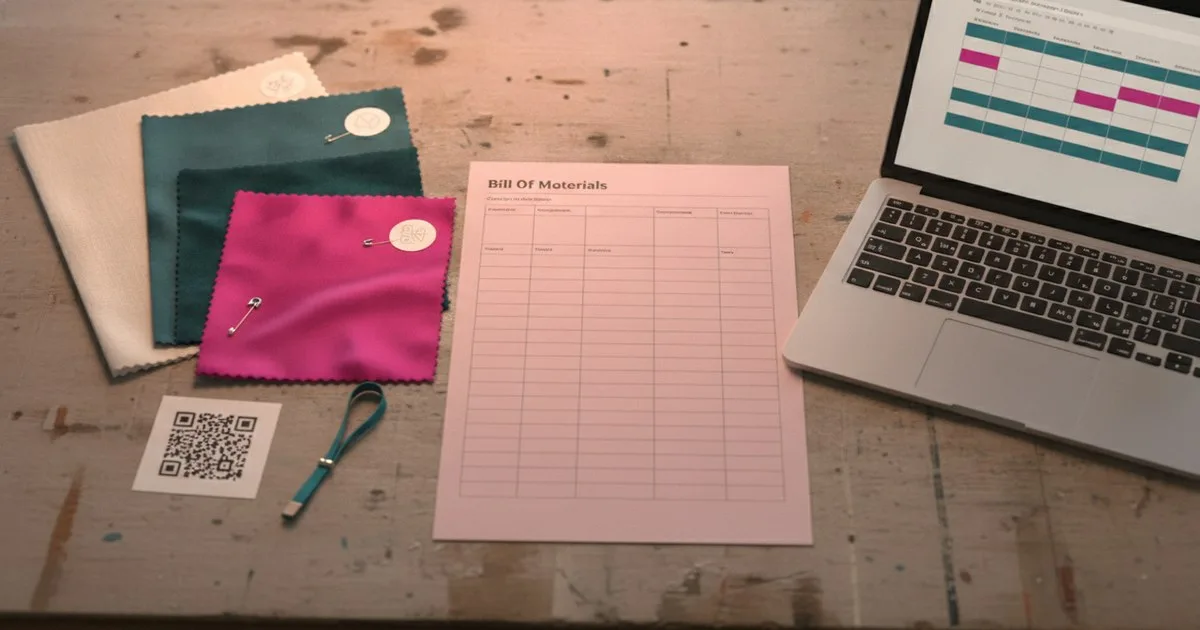
A bill of materials in apparel is already a structured list of every component in a product — fabrics, trims, labels, threads, hardware — with quantities, units, supplier references, and costs. As a guide to fashion BOMs notes, a well-maintained BOM is a living document and a core element of the tech pack, used for sourcing, costing, and production planning.
For DPP purposes, the BOM is where you should begin adding the compliance layer:
- Add country of origin to every material line. You likely have the supplier name; add the mill country and, where possible, the country where the raw fibre was grown or produced.
- Add certification fields. Create a column (or a linked field in your PLM) for each material's certification code and expiry date.
- Flag substances of concern. If a fabric uses a specific dye or finish that appears on REACH restriction lists, note it at the material line level, not just in a separate chemical inventory.
- Link care instruction codes to the BOM. Care labels are often managed separately by the graphic/label team. Bring the ISO care symbol set and the corresponding written instructions into the BOM or tech pack so they travel with the product record.
This is not a complete DPP — it is the foundation that makes a DPP possible without a last-minute data scramble.
How the tech pack connects to DPP compliance
The tech pack is the handover document from design to production. It already carries construction details, material callouts, label specifications, and quality standards. With modest additions, it becomes a primary source of DPP data:
- Material callout section: expand to include fibre content percentages, supplier name, and country. If you are already writing "Shell: 100% nylon, Supplier: Mill Name" you are halfway there.
- Label specification page: ensure the care instruction symbols are recorded as both graphic references and written text equivalents. Regulators and recyclers need the text, not just the icon.
- Sustainability notes page: add a dedicated section for environmental data — recycled content percentage, any carbon footprint figure provided by the mill, water use data if available. Even partial data captured now is more useful than none.
- Supplier contact block: include the full legal name and address of the Tier 1 manufacturer. This is often missing from tech packs that only list a factory code.
What is still unsolved
Being honest about the gaps is more useful than pretending the path is smooth.
Scope 3 emissions data is hard to get. Most fabric mills do not yet produce product-level carbon footprint data. Industry conversations — including those at events like PI Apparel New York, where digital product creation and connected workflows were a central theme — acknowledge that data availability at the supplier level remains uneven. You can start with mill-level averages and update as better data becomes available, but do not present estimates as verified figures in the DPP itself.
Tier 2 and beyond is genuinely difficult. Many brands have limited visibility past their direct (Tier 1) suppliers. The DPP framework will push this further up the chain, but the mechanisms for collecting and verifying Tier 2 data at scale are still being developed by the industry.
Delegated acts are not final. The specific data fields for textiles will be defined in delegated acts under the ESPR. The framework regulation is in force, but the textile-specific requirements are still being drafted. Build your data capture around the expected fields, but stay close to the European Commission's updates.
Data quality, not just data existence. A DPP that contains inaccurate fibre content or a supplier address that is two seasons out of date is a compliance liability, not an asset. Whatever system you use to store this data needs a version-control and update process.
Linking DPP data to your PLM
If your team uses a PLM platform, this is where DPP preparation becomes a workflow question rather than a one-time project. A platform like BeProduct — which centralises tech pack management, material and colour libraries, and supplier collaboration in a single environment — is the kind of tool that can hold DPP-relevant fields alongside the product data your team is already maintaining. When material composition, supplier details, and care instructions live in the same record as the BOM and tech pack, generating a DPP data export becomes a reporting step rather than a research project.
The practical steps for connecting your PLM to DPP readiness:
- Audit your current material library fields. Which ones already capture what the DPP needs? Which are missing?
- Add the missing fields — certification codes, country of origin at mill level, substance flags — to the material record template, not just to individual products.
- Establish a supplier data request process. Create a standard form that asks Tier 1 suppliers for the DPP-relevant data you cannot generate internally, and make returning it a condition of the purchase order process.
- Define who owns each data field. Fibre content lives with the technical team; carbon data may need to come from a sustainability function; supplier addresses need to be kept current by sourcing. Assign ownership now.
- Build a review cadence. DPP data must be accurate and up to date. Tie a data review to your existing seasonal handover process so it does not become a separate administrative burden.
Denim as an early indicator
Denim has been one of the first apparel categories to see active DPP pilot programmes. A pilot announced in August 2026 brought together a network of denim supply chain partners to test DPP data flows from mill to finished garment, according to reporting from Sourcing Journal. The lessons from denim — where supply chains are long and chemical use is significant — will inform how other apparel categories approach implementation. If your brand works in denim, getting involved in or following these pilots closely is worth the time.
Brands with technically complex products are also ahead of the curve here. A company like Arc'teryx — part of Amer Sports, itself majority-owned by Anta Sports — designs technical outdoor apparel where material traceability (Gore-Tex membranes, specific insulation types, hardware certifications) is already embedded in product development. That level of material specificity is exactly what the DPP framework rewards, and it illustrates that the data discipline required is achievable when it is built into the development process from the start.
What to do this season
You do not need to wait for the delegated acts to be finalised before you start. Here is a practical sequence:
- Audit one product category. Pick a current-season style and try to assemble every DPP data field from your existing records. Note what you have, what is missing, and where you would go to get it.
- Update your BOM and tech pack templates. Add the fields that are missing — country of origin, certification codes, care instruction text, Tier 1 legal name and address.
- Send a supplier data request. Ask your Tier 1 factories to return fibre content confirmation, their own supplier information (Tier 2), and any environmental data they hold.
- Choose a home for the data. Whether that is your PLM, an ERP, or a structured spreadsheet for now, the data needs a single authoritative location per product.
- Assign ownership and a review date. DPP data is only useful if it stays accurate.
The brands that will find DPP compliance straightforward are the ones that treat it as a data quality project starting now, not a compliance project starting when the deadline arrives.
FAQ
What is a digital product passport in fashion? A digital product passport is a structured electronic record attached to a garment that stores sustainability, traceability, and material data. It is required under the EU's Ecodesign for Sustainable Products Regulation and must be accurate, complete, and accessible to consumers, supply chain actors, and customs authorities before a product can be placed on the EU market.
When will digital product passports be required for apparel? The ESPR framework regulation is already in force. Textile-specific requirements will be set by delegated acts that are still being drafted. Production teams should treat preparation as an active project now rather than waiting for a final deadline, as data collection across supply chains takes time to establish.
What data fields does a DPP need for a garment? Expect to need: fibre content by percentage, country of origin for materials, Tier 1 and Tier 2 supplier details, care and disassembly instructions, recyclability information, and environmental performance data including carbon footprint where available. The exact mandatory fields will be confirmed in the textile delegated act.
How does a BOM connect to a digital product passport? A BOM already lists every component in a garment with supplier references and quantities. Adding fields for country of origin, material certifications, and substance flags to each BOM line turns it into a primary data source for DPP generation, avoiding a separate data-collection exercise at compliance time.
Can a PLM platform help with DPP compliance? Yes. A PLM that centralises material libraries, tech packs, and supplier data in one place can hold DPP-relevant fields alongside the product records your team already maintains. When the data lives in one system, generating a DPP data export is a reporting step rather than a research project.
What is the hardest part of DPP preparation for production teams? Scope 3 emissions data and Tier 2 supplier visibility are the most commonly cited challenges. Many mills do not yet produce product-level carbon data, and supply chain visibility past Tier 1 is limited for most brands. Start with what you can verify and build a process for collecting the rest from suppliers progressively.
Further reading
- Regulation (EU) 2024/1781 — Article 9 Digital Product Passport
- ESPR overview — European Commission
- New Digital Product Passport Pilot for Denim Suppliers — Sourcing Journal