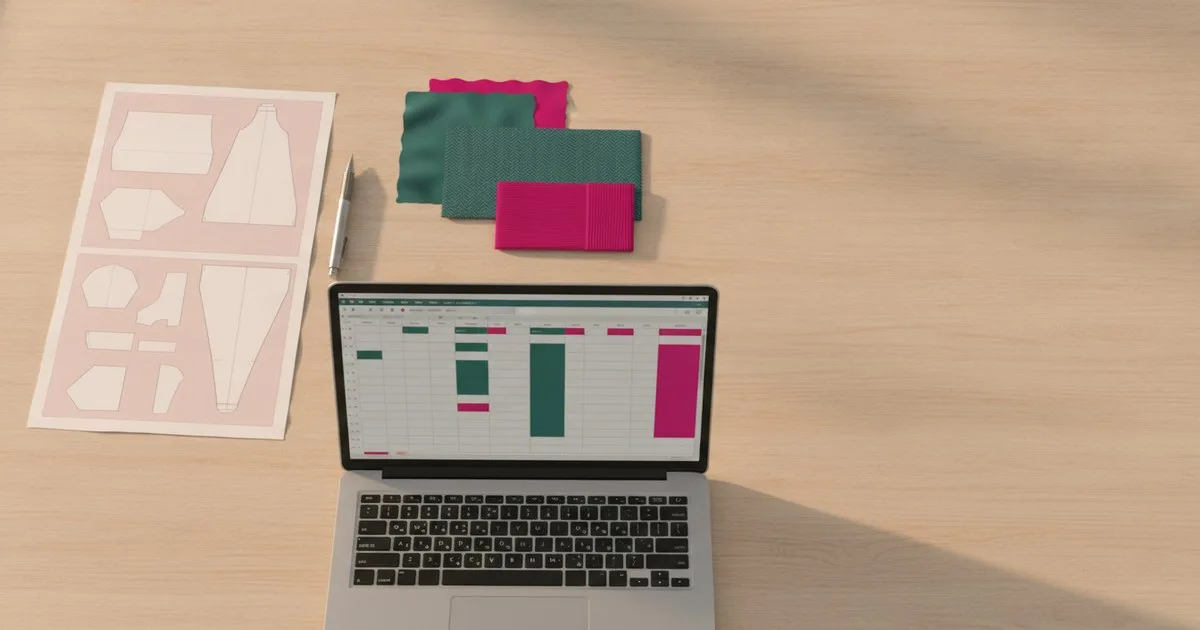
AI tools can produce a rough tech pack draft faster than any junior technical designer working alone — but rough is the operative word. For production teams, the real question is not whether AI can help, but exactly which parts of a tech pack you can hand off to it and which parts will come back wrong if you do. This article maps both sides clearly, so you can build a workflow that is genuinely faster without shipping inaccurate documents to your factory.
Key takeaways
- AI reliably accelerates cover page population, flat sketch extraction, and initial BOM drafting, cutting early-stage admin time significantly.
- Tolerance setting, construction sequencing, and seam-compatibility checks remain tasks where human expertise is non-negotiable.
- Research into bridging physics-based simulation with CAD pattern logic shows that even computational tools struggle to automatically fix patterns when drape behaviour is involved.
- Production teams that treat AI output as a first draft — not a finished document — report fewer factory revision cycles.
- The governance gap is real: fashion's AI adoption is moving faster than the trust and review processes needed to catch AI errors before they reach suppliers.
What exactly is a tech pack, and why does it matter for AI?
A tech pack is the complete technical document a brand sends to a manufacturer so the factory can produce a garment without guessing. It typically includes a cover page with style information, flat technical sketches (front and back), a bill of materials (BOM) listing every component and trim, construction details, measurements and grading, tolerances, care label instructions, and quality checkpoints.
Every section has a different character. Some are largely administrative — repeating brand information, season codes, colourways. Others are deeply judgement-based — deciding how much ease to allow at a seam, or in what order a factory worker should assemble panels so the topstitching lands correctly. AI tools are good at the first kind of task and unreliable at the second. Understanding that distinction is the starting point for any sensible AI-assisted workflow.
Where AI genuinely helps: the tasks worth automating
Cover page and style header population
This is the lowest-risk, highest-return area. Cover pages repeat structured data: brand name, season, style number, colourway codes, fabric composition, target country of origin. If that data lives in a PLM system or a spreadsheet, an AI layer can pull it into a template reliably. Backbone PLM, now operated under Bamboo Rose, provides PLM tooling that connects product development data to supplier-facing documents — the kind of structured data environment where auto-population works well.
The risk here is version control, not accuracy. Make sure the AI is reading the current data source, not a cached or earlier version.
Flat sketch extraction from design files
Vision-capable AI models can take a rendered design image and produce a clean flat technical sketch — front and back views, with seam lines, pocket placement, and topstitching indicated. Tools such as The F* Word advertise editable tech pack drafts generated in under ten minutes from a design input.
What you get is a usable starting point, not a finished sketch. Expect to correct:
- Pocket depth and internal construction details (AI infers these from the exterior view)
- Collar or waistband construction lines that are implied but not visible
- Symmetry errors on complex curved seams
A technical designer reviewing the AI sketch for ten minutes is still faster than drawing from scratch.
Initial BOM population
If your design file or brief names fabrics, trims, and hardware, AI can draft a first BOM — pulling component names, suggesting standard descriptions, and flagging obvious omissions (a zip on the sketch but no zip in the BOM). This saves the copy-and-paste work of building a BOM shell.
What it cannot do reliably: assign correct supplier codes, specify thread colour numbers, or confirm that a named fabric is available from your approved vendor list. Those steps need a human with access to your actual sourcing data.
Colourway and care label drafting
AI handles repetitive text generation well. Given a fabric composition, it can draft a care label instruction set that follows standard symbols and regional requirements. Given a colourway brief, it can generate the formatted colour-name and Pantone-reference rows for each option. Both outputs need checking — care label regulations vary by market — but the drafting time drops substantially.
Where AI fails: the tasks that need your expertise
Tolerance setting
Tolerances — the acceptable measurement variance at each point on a garment — are not derivable from a sketch. They depend on the fabric's stretch and recovery, the factory's machinery capability, the fit model's body, the brand's quality standard, and the garment's end use. A performance jacket worn in wet conditions has different tolerances at the underarm seam than a dress shirt.
AI models trained on general fashion data have no access to your factory's capability data, your fit history, or your brand's quality threshold documents. Any tolerance values an AI suggests are statistical guesses. In our experience, production teams that accept AI-generated tolerances without review end up with either over-tight specs that cause unnecessary rejections or over-loose specs that let quality problems through.
Set tolerances yourself, or use your existing approved spec sheets as the source.
Construction sequencing
The order in which a factory assembles a garment affects quality, cost, and whether certain details are even physically possible. Attaching a welt pocket before closing a side seam, for example, is standard — reversing that order makes the pocket impossible to finish cleanly. Construction sequencing requires understanding of industrial sewing processes, not pattern geometry.
Current AI tools work from visual and textual inputs. They do not model the physical constraints of assembly. Research published on arXiv in early 2026 introduced a framework called Textile IR, a bidirectional intermediate representation that attempts to connect manufacturing-valid CAD, physics-based simulation, and lifecycle assessment — specifically because existing tools treat pattern software and simulation as separate silos. Even with that kind of computational scaffolding, the authors describe a seven-layer verification process from basic syntactic checks to expensive physics validation. If researchers building dedicated infrastructure for this problem need seven verification layers, a general-purpose AI drafting tool is not going to get construction sequencing right from a sketch.
Write construction notes yourself, or adapt them from a validated reference garment in your archive.
Seam compatibility and pattern closure
A tech pack's construction details must be consistent with the pattern. If the flat sketch shows a French seam at the side, the seam allowance on the pattern must accommodate it. AI tools generating tech packs from sketches have no access to the pattern file — they cannot check seam compatibility. Errors here do not show up until the first sample, which is an expensive place to find them.
Grading rules
Grading — scaling a base size pattern up and down across a size range — follows rules that are brand-specific and garment-specific. AI can apply generic grading increments, but those will not match your brand's fit standards or your customer's body proportions. Grading errors compound: a small error at the hip on a size 8 becomes a larger error by size 16. This is a task for a trained grader working from your brand's grading specification.
The governance gap: why speed creates new risk
Fashion's AI adoption is accelerating, but as industry observers noted in mid-2026, trust, governance, and readiness are struggling to keep pace with the tools themselves. For tech packs specifically, this means two things.
First, AI-generated documents look finished. A well-formatted cover page and a clean BOM table give the impression of a reviewed document even when the content has not been checked. Factories act on what they receive. If an AI-drafted spec with wrong tolerances reaches a supplier, the factory will cut to those tolerances.
Second, review processes designed for human-drafted documents may not catch AI-specific error patterns. Human drafters make errors of omission — they forget a trim. AI tools make errors of plausible invention — they include a trim that sounds right but is not in your approved list. Your QA checklist needs to account for both.
A practical fix: treat every AI-generated section with a status tag in your PLM — "AI draft, unreviewed" — and require a named reviewer to clear it before the document is released to a supplier. Backbone PLM's approvals workflow supports this kind of gated release.
A practical split: what to automate and what to own
| Tech pack section | AI role | Human role |
|---|---|---|
| Cover page / style header | Auto-populate from PLM data | Verify version and season codes |
| Flat sketches | Generate first draft | Correct construction details and symmetry |
| BOM shell | Draft component list from brief | Add supplier codes, confirm availability |
| Colourway rows | Draft names and reference fields | Confirm Pantone accuracy |
| Care label text | Draft by fabric composition | Check market-specific regulations |
| Tolerances | Do not use AI output | Set from fit history and factory capability |
| Construction notes | Do not use AI output | Write from reference garments or standards |
| Grading rules | Do not use AI output | Apply brand grading spec |
| Seam compatibility | Cannot check without pattern | Verify against pattern file |
How to build an AI-assisted tech pack workflow
What you need before you start
- A PLM or structured data source with current style, fabric, and supplier data
- A validated flat sketch or design render
- Your brand's approved BOM component list and supplier codes
- Your grading specification document
- Your factory's capability data (machinery, seam allowance norms)
Steps
- Run the cover page. Point your AI tool at your PLM data and generate the style header. Check season code, colourway count, and fabric composition against the source.
- Generate flat sketches. Upload your design render and produce front and back technical flats. Mark every line the AI has inferred (pocket interior, collar construction) for manual review.
- Draft the BOM shell. Use the AI output as a checklist scaffold. Add your supplier codes and confirm each component against your approved vendor list. Delete any component the AI invented that is not in your sourcing data.
- Draft care labels and colourway rows. Review against your target market's labelling requirements — these change by country and fibre type.
- Stop and switch to manual for tolerances. Pull your approved spec sheet for the closest reference garment. Adapt tolerances from there, not from AI suggestions.
- Write construction notes from a reference. Use a validated tech pack for a similar garment as your starting point. Adjust for this style's specific details.
- Tag every section with review status in your PLM. Release to supplier only after a named technical designer has cleared each section.
- First sample review. Compare the sample against every AI-drafted section specifically — check that the BOM components are what actually arrived, and that the sketches matched what the factory interpreted.
Brands operating at scale are learning this the hard way
Large athletic and performance brands — Nike among them — run product lines with hundreds of SKUs per season, each with its own performance specification, material stack, and construction requirement. At that volume, even small AI errors in BOM population or tolerance setting multiply into significant rework costs. The brands that are integrating AI tools successfully are doing so with strict human review gates, not by replacing technical designers.
The lesson for smaller production teams is the same: AI buys you time on the administrative and visual drafting work. It does not replace the technical judgement that makes a spec manufacturable.
FAQ
Can AI generate a complete, factory-ready tech pack without human review? Not reliably. AI can draft most sections quickly, but tolerances, construction sequencing, and seam compatibility require human expertise and access to data — fit history, factory capability, pattern files — that AI tools do not have.
What is the biggest risk of using AI-generated tech packs? AI output looks polished even when it contains errors. Plausible-sounding but wrong tolerances or BOM components can reach a factory before anyone catches them. The fix is a gated review process in your PLM before any document is released to a supplier.
How accurate are AI-generated flat sketches? Useful as a starting point, not as a finished drawing. AI infers interior construction from the exterior view, which means pocket depth, collar construction, and curved seam details are frequently wrong. A ten-minute technical review is faster than drawing from scratch, but the review is not optional.
Which parts of a tech pack are genuinely safe to automate? Cover page population from structured PLM data, BOM shells, colourway rows, and care label drafts are the lowest-risk areas. Tolerances, grading rules, and construction notes should not be delegated to AI with current tools.
Does AI help more for simple garments than complex ones? Yes. A basic T-shirt with few seams and standard trims gives AI less opportunity to invent incorrect details. A technical outerwear piece with bonded seams, waterproof zips, and multiple internal layers has far more construction decisions that AI cannot reliably infer from a sketch.
Will AI get better at the parts it currently gets wrong? Research into connecting pattern CAD with physics-based simulation suggests the field is working on it, but bridging manufacturing-valid patterns with drape simulation is a hard problem that even dedicated computational frameworks address through multi-layer verification — not instant generation. For production teams today, the manual steps described above remain necessary.
Further reading
- What Is a Tech Pack? The Complete Fashion Guide
- Textile IR: A Bidirectional Intermediate Representation for Physics-Aware Fashion CAD
- Week in review: Fashion's AI ambitions meet a reality check