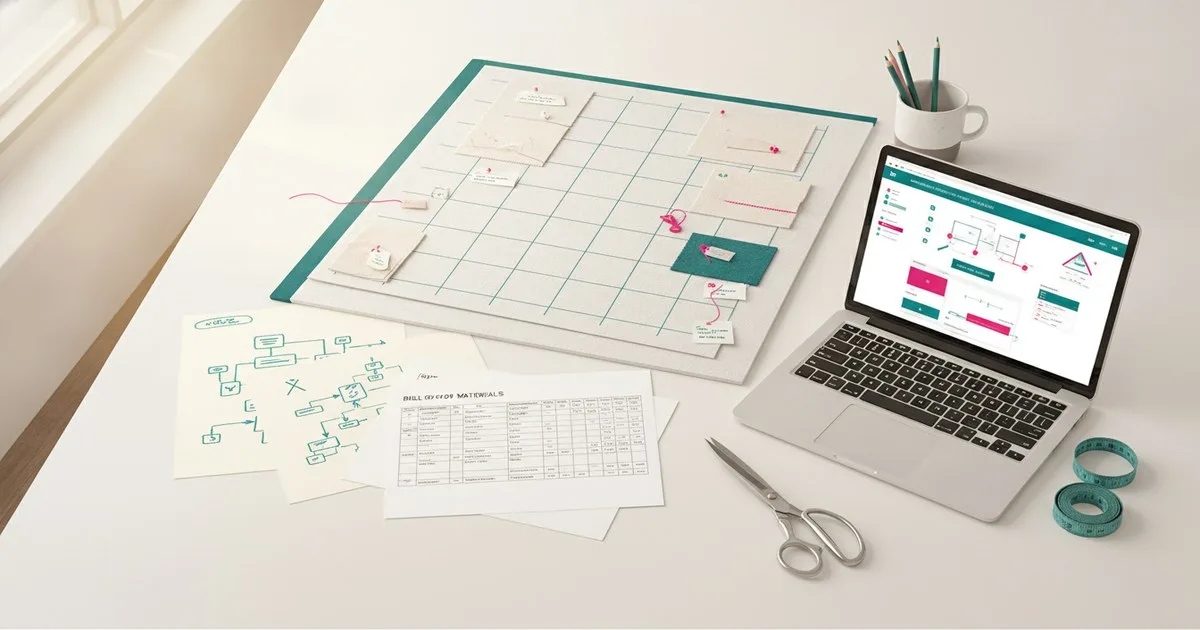
If your team has ever spent an afternoon hunting for the "real" version of a spec sheet, you already understand the problem PLM exists to fix. A product lifecycle management system gives every department—design, sourcing, and production—a single record they all read from and write to, eliminating the version-control chaos that slows handovers and causes costly rework. This article explains the mechanism, the data flows, and the gaps that still require human judgment.
Key takeaways
- A PLM system stores the design brief, bill of materials, sourcing decisions, and production milestones in one linked record, so changes in one area propagate automatically to the others.
- The biggest time saving comes not from faster individual tasks but from eliminating the reconciliation work between teams—chasing confirmations, cross-checking file versions, and re-entering data.
- A BOM inside a PLM is a living document: development costing and actual landed cost can sit on the same record, updated as sourcing decisions are confirmed.
- PLM does not replace human judgment on supplier relationships, quality calls, or creative direction—it creates the structure those decisions are recorded in.
- Implementation only works if every team commits to entering data in the system; a PLM that design ignores is just another silo.
Why does the design-to-production handover keep breaking?
The short answer: data lives in too many places. A designer finalises a colourway in one file. A merchandiser updates the BOM in a spreadsheet. A sourcing manager emails a factory a different version of the tech pack. By the time production starts cutting, three people hold three different documents—and nobody is certain which one governs.
This is not a discipline problem. It is a structural one. When product data has no single home, every handover becomes a reconciliation exercise. Teams spend time confirming facts rather than acting on them. Mistakes that should be caught at the spec stage surface on the factory floor, where they cost far more to fix.
Fashion brands running a centralised PLM platform report cutting time-to-market by 30–35%, not because designers work faster, but because nobody has to spend an afternoon confirming which version of a spec is actually current.
What is a PLM system, exactly?
PLM stands for product lifecycle management. In apparel, it is the software layer that holds every piece of data about a product—from the first design brief through sampling, sourcing, production, and delivery—in one structured record.
Think of it as a shared workspace where:
- Design stores sketches, colourways, material callouts, and construction notes.
- Sourcing logs supplier quotes, approved vendors, lead times, and material certifications.
- Production tracks sample rounds, fit comments, approval status, and milestone dates.
- Costing links material costs to the BOM so target cost and actual cost sit side by side.
Every update is timestamped and visible to the whole team. There is no "FINAL_v3_REVISED_actualfinal.pdf"—there is one record, and everyone knows it.
How does PLM link the design brief to the BOM?
The design brief is where a product record starts. In a PLM, the brief is not a PDF attachment—it is a structured entry: silhouette, target market, seasonal positioning, key materials, and cost target. Those fields are live data, not a document.
From the brief, the bill of materials grows. As the designer specifies a shell fabric, a lining, a zipper, and a label, each component becomes a line in the BOM. The BOM is not a separate spreadsheet—it is embedded in the product record, so when a material is swapped (say, a woven shell replaced with a bonded knit), the change is visible immediately to sourcing and costing.
A well-structured BOM inside a PLM acts as a living document: development costing and actual landed cost can sit on the same record, updated as sourcing decisions are confirmed. That means your target margin is always calculated against current, real costs—not the estimate from three months ago.
How does sourcing plug into the same record?
Once the BOM has a material list, sourcing can act on it directly inside the PLM. Rather than receiving an emailed spreadsheet and working in parallel, your sourcing team sees the same record the designer built. They can:
- Assign an approved vendor to each BOM line.
- Log quotes, minimum order quantities, and lead times against each component.
- Flag a substitution if a preferred material is unavailable, with the reason recorded.
- Attach supplier compliance documents (test reports, certifications) to the relevant line.
When sourcing confirms a vendor, that decision is immediately visible in the product record. Production can see which factory is cutting which fabric before the purchase order is even raised. No email chain required.
This is where platforms like BeProduct and WFX focus a significant part of their feature sets: connecting material libraries, vendor databases, and BOM management so that sourcing decisions are recorded in the same environment where the tech pack lives. Backbone PLM, now part of Bamboo Rose, takes a similar approach for retailers managing private-label development at scale.
How do production milestones attach to the same record?
This is where PLM earns its keep for your team specifically. Once sourcing is confirmed, the production workflow—sample requests, fit sessions, approval gates, bulk order milestones—can be tracked inside the same product record.
A typical production milestone chain in a PLM looks like this:
- Proto sample requested — spec issued from PLM, linked to the current tech pack version.
- Proto received and reviewed — fit comments logged against the record; revised spec issued from the same record.
- Salesman sample approved — approval status updated; bulk order triggered.
- Bulk fabric inspection — result logged; any deviation from spec flagged against the BOM line.
- Final inspection — pass/fail recorded; shipment details attached.
Every step is dated, attributed to a user, and visible to design, sourcing, and production simultaneously. If a fit comment changes a seam allowance, the tech pack version updates in the same record—there is no separate email to send.
Connected workflows like these were a central topic at PI Apparel New York in 2026, where the conversation focused on how digital product creation, automation, and connected workflows can solve real operational problems for fashion businesses.
What does a PLM still not solve?
Being honest about the limits matters, because a PLM is not a magic system.
Supplier relationships. A PLM records which vendor is assigned and what they quoted. It does not manage the relationship—the trust, the negotiation, the phone call when a shipment is at risk. That is still human work.
Creative judgment. PLM structures creative decisions; it does not make them. The choice between two colourways, the call to drop a style from a range, the instinct that a sample is not right—those stay with your team.
Data quality. A PLM is only as good as what goes into it. If design enters a material callout as "navy blue fabric" instead of the mill reference and weight, sourcing cannot act on it. Garbage in, garbage out applies here as firmly as anywhere.
Integration with factory systems. Most PLMs communicate with factories through portals or structured file exports, not live system-to-system connections. The factory's own production management software is usually separate. Bridging that gap is still an active area of development across the industry.
Tech pack drafting speed. PLM manages and stores tech packs; it does not typically generate them quickly. Some teams use dedicated tools alongside their PLM to accelerate the drafting step before data is entered into the main record.
Which PLM platforms should production teams know about?
Here is a practical overview of the options most relevant to fashion production teams, from lean startups to mid-market brands:
| Platform | What it is | Best for | Limits |
|---|---|---|---|
| BeProduct | SaaS PLM and digital product creation platform with tech pack management, material and colour libraries, sample tracking, and real-time collaboration | Emerging and scaling brands that need affordable, structured PLM without a long implementation | Fewer deep ERP integrations than enterprise-tier systems |
| WFX | Digital commerce services platform with PLM and ERP capabilities for fashion and apparel | Brands that need PLM alongside broader commerce and supply chain management | Feature depth varies by module; assess against your specific workflow |
| Backbone PLM (part of Bamboo Rose) | PLM tooling for product development workflows including tech packs, approvals, and supplier collaboration, targeting retailers managing private-label at scale | Retailers and scale-up brands running private-label programmes | Post-acquisition, integration work has absorbed some engineering focus; evaluate current roadmap carefully |
The right choice depends on your team size, your existing tech stack, and how much of your workflow you want to manage inside one system versus across connected tools.
How do you get your team to actually use it?
This is the question most PLM rollouts underestimate. The technology is the easier part.
- Start with one season, one category. Do not migrate everything at once. Prove the value on a contained range first.
- Map your current workflow before you configure the system. PLM is flexible, but it works best when it mirrors how your team actually operates—not an idealised version of it.
- Make data entry the path of least resistance. If logging a fit comment in the PLM takes longer than sending an email, people will send the email. Configure templates and shortcuts so the system is faster than the workaround.
- Agree on who owns each field. Design owns the material callout. Sourcing owns the vendor assignment. Production owns the milestone status. Ambiguity about ownership is how data quality degrades.
- Review the record in your existing meetings. Pull the PLM record up in your weekly production meeting instead of a separate status spreadsheet. That habit change alone drives adoption faster than any training session.
FAQ
What is the difference between PLM and ERP in fashion? PLM manages product development data—specs, BOMs, samples, approvals—from concept through production sign-off. ERP manages business operations—inventory, orders, financials, fulfilment. In practice, they overlap at the point where a confirmed product record triggers a purchase order; some platforms cover both, others integrate.
Can a small brand justify PLM, or is it only for large companies? Smaller brands benefit from PLM too, though the calculus is different. If you are managing more than two or three seasonal ranges and your team is spending significant time reconciling versions, a lightweight SaaS PLM pays for itself quickly. Platforms like BeProduct are priced for emerging brands, not just enterprise.
How does PLM handle tech pack versioning? A PLM stores each issued version of a tech pack with a timestamp and the user who made the change. When a spec is revised after a fit session, the new version is the active record and the previous version is archived but retrievable. Factories receive the current version from the system, not from an email attachment.
Does PLM connect directly to factories? Most PLMs offer a supplier portal—a web interface where factories can view specs, log comments, and upload sample photos without needing a full licence. Direct system-to-system integration with factory production software is less common and usually requires custom work.
What data should we migrate first when implementing PLM? Start with your active BOM templates and approved vendor list. Those two datasets unlock the most immediate value: sourcing can act on live BOMs, and vendor assignments are recorded centrally from day one. Historical data can follow once the team is comfortable with the system.
How does PLM help with costing accuracy? Because the BOM and sourcing decisions live in the same record, cost calculations update automatically when a vendor quote changes or a material is substituted. Development cost and actual landed cost can sit on the same BOM line, so your margin picture is always based on current data rather than a static estimate.
Further reading
- PLM for Textile Design: Streamline Product Development
- A Guide to the Bill of Materials (BOM) in the Fashion Industry