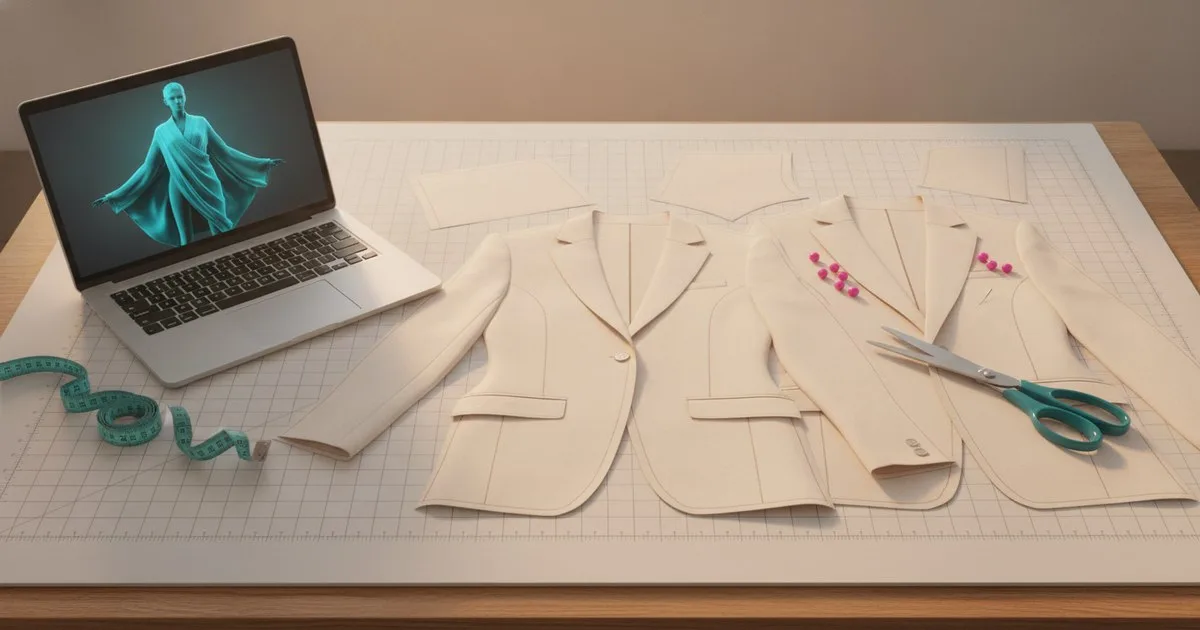
3D garment simulation can meaningfully reduce your physical sample count, speed up fit approvals, and give your design-to-production handover more structure — but only when you deploy it on the right product categories, at the right moment in development. Apply it indiscriminately and you'll spend more hours setting up simulations than you would have spent shipping and reviewing a physical sample. This guide gives you a clear framework for making that call.
Key takeaways
- Physical sampling costs average roughly $1,548 per style, according to research published in the Journal of Textile Engineering & Fashion Technology — a figure that makes the ROI case for virtual sampling compelling on high-iteration styles.
- The ROI of 3D simulation is highest on structured, repeatable silhouettes; it is weakest on highly draped or bias-cut styles where fabric behaviour is hardest to calibrate.
- Fabric property measurement is not yet standardised across software platforms, which means a simulation validated in one tool may not transfer cleanly to another.
- The best teams treat 3D as a decision gate, not a replacement for every physical sample.
- Tool choice matters: different platforms are optimised for different workflows, from entertainment-oriented drape to production-grade pattern validation.
What does 3D garment simulation actually do?
At its core, 3D garment simulation takes a 2D pattern — the same flat pieces your pattern maker would cut from fabric — and drapes them onto a digital avatar using physics-based calculations. The software models how the cloth behaves under gravity, tension, and body movement: where it pulls, where it hangs, where seams pucker.
The output is a visual and, increasingly, a technical one. Modern platforms generate not just a rendered image but annotated fit comments, graded size previews, and assets that feed directly into a tech pack or a PLM system. That last step is where the production value really sits.
Where does 3D simulation pay off?
High-iteration, structured silhouettes
If your team typically runs four or five fit samples on a tailored jacket or a structured trouser before sign-off, 3D simulation can compress that to one or two. Structured garments — blazers, trousers, shirts, outerwear shells — behave predictably in simulation because their construction is relatively rigid and their patterns are well-defined. The software's physics engine can model the interplay between interfacing, seam allowances, and body shape with enough accuracy to catch a shoulder pitch problem or a back-rise issue before you cut a single metre of fabric.
This is the core use case for platforms like Browzwear, whose VStitcher tool is built around production-grade pattern validation and fit review. Browzwear's workflow connects the 3D simulation directly to technical and e-commerce asset generation, so a fit-approved virtual sample can feed downstream steps without a separate export process.
Range planning and early-stage design reviews
3D simulation is particularly effective at the range-planning stage, when you're deciding which silhouettes make it to sampling at all. Showing a buyer or merchandising team a physics-based render of ten colourways on a graded avatar costs a fraction of what it would take to produce even one physical sample per option. Decisions that used to require a showroom full of proto samples can happen in a shared digital workspace.
Branded and decorated apparel
For styles where the key variable is artwork placement rather than fit — a print tee, an embroidered sweatshirt, a decorated cap — 3D visualisation delivers fast, accurate proofing without the complexity of a full physics simulation. Seddi's Decorator platform, for example, creates true-to-pattern digital replicas of real blank garments specifically for artwork placement and client approval, sitting between a full simulation tool and a flat mockup generator.
Fabric development and material libraries
When you're evaluating a new fabric supplier or testing a material substitution, 3D simulation lets you visualise how the new cloth will behave on your existing blocks before you commit to a bulk order. Platforms that support digital fabric twins — where real fabric properties are measured and encoded — make this particularly useful for comparing handle and drape across options.
Where does 3D simulation cost more than it saves?
Highly draped, bias-cut, and unstructured knitwear
This is the category where production teams most often feel burned by 3D. Chiffon blouses, bias-cut dresses, and fine-gauge knitwear depend on subtle fabric properties — drape coefficient, bending rigidity, surface friction — that are genuinely difficult to encode accurately. A critical review published by the IEEE Standards Association found that there is no coherency between the methods different software packages use to measure fabric properties, and that simulated results for the same fabric vary significantly between platforms. For a bias-cut dress, that variance can be the difference between a simulation that looks approved and a physical sample that doesn't fit.
The practical implication: on draped and unstructured styles, treat 3D as a communication tool — useful for showing intent to a buyer or a supplier — rather than a fit-validation tool. Keep your physical sample in the process.
One-off or very low-volume styles
Setting up an accurate simulation takes time. You need a calibrated fabric file, a correctly graded pattern in a compatible format, and an avatar that matches your fit model's measurements. For a style that will only be made in one size in one colourway for a single client, the setup cost often exceeds the cost of just making the sample. The break-even point varies by team and tool, but as a rule of thumb: if a style has fewer than three colourways or fewer than three size runs, run the numbers before committing to a virtual workflow.
Highly technical construction details
3D simulation is strong on silhouette and fit but weaker on construction-level detail. Topstitching, bonded seams, welted pockets, and multi-layer quilting are difficult to render with production accuracy. Your factory's pattern maker needs to see the physical result of those construction choices, not a render. Use 3D to approve the shape; use a physical sample to approve the make.
Which tool fits which workflow?
The right platform depends on where in your process you're applying simulation and what your team's technical baseline looks like.
| Tool | Best for | Limits |
|---|---|---|
| Browzwear VStitcher | Production teams validating fit on structured garments; brands that need PLM/ERP connectivity and want to generate tech pack and e-commerce assets from the same environment | Steeper learning curve; full value requires investment in fabric digitisation and avatar calibration |
| Marvelous Designer | Teams that need fast, visually accurate drape for design communication and range presentation; now includes an AI Pose Generator and a Pattern Drafter (beta) for converting measurements into patterns | Originated in entertainment/games workflows; production handover requires additional steps to reach factory-ready output |
| Seddi Decorator | Branded and decorated apparel teams focused on artwork placement, client proofing, and production instructions rather than full physics simulation | Scoped to decorated/blank garments; not a full garment construction simulator |
Marvelous Designer is now part of CLO Virtual Fashion, which has expanded its AI-assisted pattern and pose generation capabilities in recent releases. If your team already works in a CLO ecosystem, the integration path is straightforward.
How to build a decision gate into your development calendar
The teams that get consistent ROI from 3D simulation treat it as a formal gate in the development calendar, not an ad hoc step. Here's a practical structure:
- At range planning: Use 3D renders for all styles to support buyer presentations. No physical samples at this stage.
- At proto approval: Apply full physics simulation to structured styles with three or more colourways. Flag draped and unstructured styles for physical proto only.
- At fit approval: Use 3D for graded size review on approved silhouettes. Physical fit session remains mandatory for draped, bias-cut, and highly technical styles.
- At pre-production: Use 3D assets to populate tech pack visuals and e-commerce imagery where the simulation has been validated against a physical sample.
This structure keeps 3D effort concentrated where it delivers, and protects your physical sampling budget for the categories where simulation still falls short.
What's still unsolved
Fabric calibration remains the field's biggest open problem. Getting a digital fabric file that behaves the same way across different simulation platforms — or even consistently within one platform across different machines — requires careful measurement protocols that most production teams don't have the lab infrastructure to run. The IEEE review cited above makes clear that the industry has not yet agreed on a standard measurement method, which means that a fabric file built for one tool may produce meaningfully different results in another.
Avatar standardisation is a related gap. Most platforms ship a library of standard avatars, but unless your fit model's measurements are encoded into the system, the simulation is validating fit against a generic body, not yours. Building and maintaining a calibrated avatar library is a one-time investment that pays back quickly on high-volume styles — but it's a step many teams skip.
Finally, construction detail rendering is still catching up to physical reality. The gap is narrowing, but for now, plan your workflow around it rather than waiting for it to close.
FAQ
When does 3D garment simulation actually save money? It saves most reliably on structured silhouettes with multiple colourways or size runs, where the cost of physical samples across the range exceeds the setup time for a calibrated simulation. Research puts average physical sampling cost at around $1,548 per style, so even eliminating one round of physical samples on a multi-colourway style can justify the investment.
Can 3D simulation replace physical fit sessions entirely? Not yet, and not for all categories. For structured garments on well-calibrated avatars, teams regularly reduce physical samples to a single confirmation round. For draped, bias-cut, or highly technical styles, physical fit sessions remain necessary because fabric behaviour in simulation diverges from reality in ways that matter to the fit.
How long does it take to set up a 3D simulation for a new style? For a team with an established fabric library and calibrated avatars, a structured style can be simulation-ready in a few hours. For a new fabric that needs to be digitised, or a new avatar that needs to be built from fit model measurements, add a day or more. Factor setup time into your ROI calculation before committing to a virtual workflow on low-volume styles.
Does the 3D simulation output feed directly into a tech pack? With production-oriented platforms, yes — annotated renders, graded size views, and measurement tables can be exported and used to populate tech pack templates. The degree of automation depends on your PLM setup and whether the simulation tool integrates with it.
Is fabric calibration really that different across platforms? Yes. An IEEE Standards Association review of fabric measurement methods for virtual simulation found that simulated results for the same fabric vary significantly between software packages, and that there is no agreed standard for how fabric properties should be measured for input. If your team uses more than one simulation tool, you may need separate fabric files for each.
What garment categories should we avoid simulating? Start by deprioritising bias-cut wovens, fine-gauge knitwear, heavily draped styles, and garments where construction detail — bonded seams, complex quilting, welted pockets — is the primary quality variable. Use 3D for shape communication on these styles, but keep physical samples in the approval process.
Further reading
- Advancing sustainable fashion through 3D virtual design for reduced environmental impact — Journal of Textile Engineering & Fashion Technology
- The Measurement of Fabric Properties for Virtual Simulation — A Critical Review — IEEE Standards Association