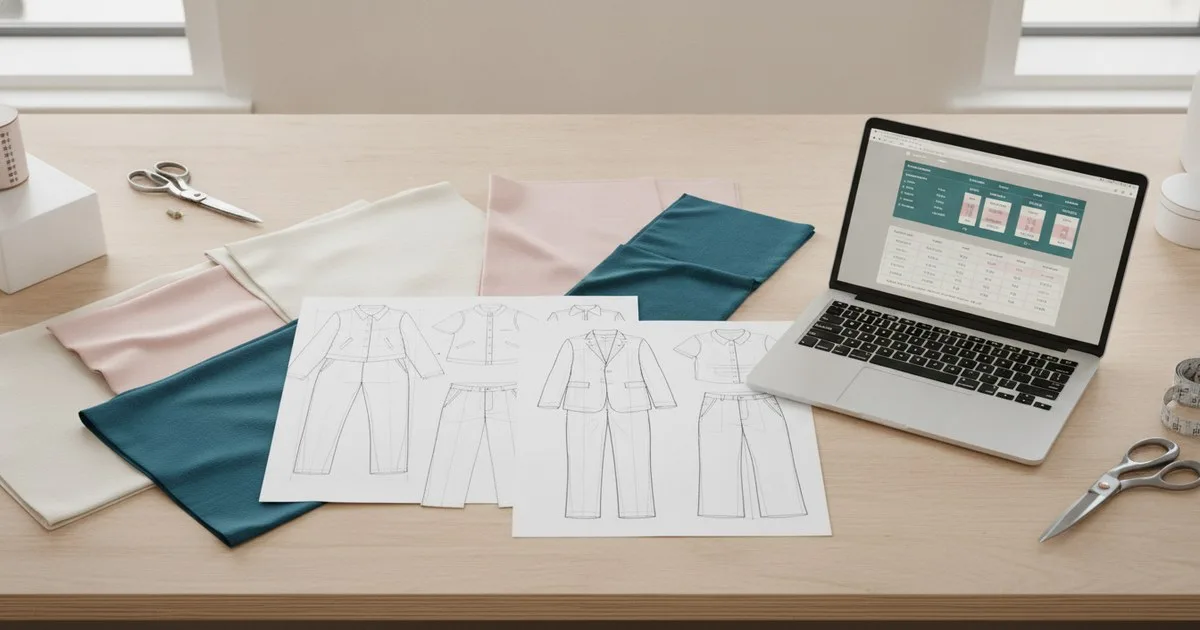
If your team is still chasing product information across email threads, shared drives, and disconnected spreadsheets, you already know the cost: late samples, costing errors, and handover friction between design and the factory floor. Centric PLM, now part of Dassault Systèmes, was built to collapse that sprawl into a single, authoritative product record that travels with each style from first sketch to bulk delivery.
Key takeaways
- Centric PLM sits inside the Dassault Systèmes group and ships an AI-powered platform covering PLM, planning, pricing, and product experience management for fashion, cosmetics, and retail.
- Its core value for production teams is a live product record — tech pack, BOM, costing, and supplier data — that updates in one place and propagates everywhere.
- The platform has expanded well beyond PLM: Centric Planning, Centric Market Intelligence, and Centric PXM (a PIM/DAM layer) are now part of the same suite.
- Where the product record ends and the ERP begins is a real integration question that every implementation team has to answer before go-live.
- Smaller or faster-moving brands often find the platform's breadth more than they need; purpose-built SaaS PLM tools remain a practical alternative at that scale.
What did Centric Software become known for?
Centric Software built its reputation solving a problem that had plagued mid-to-large apparel brands for years: the product record that existed in five places simultaneously and was authoritative in none of them. Early adopters were brands managing high SKU counts across multiple seasons, where the cost of a misaligned BOM or an unsigned-off tech pack showing up at a factory was measured in air-freight bills and margin erosion.
The platform earned traction by being genuinely purpose-built for consumer goods — not a horizontal ERP with a fashion module bolted on. That positioning resonated with production and sourcing managers who had spent years working around systems that did not understand the concept of a colorway, a size run, or a graded spec sheet.
Over time, Centric Software grew its customer base across fashion, footwear, outdoor, cosmetics, and food and beverage — sectors that share the underlying challenge of managing complex, rapidly iterating product catalogs with global supply chains.
What does Centric PLM ship today?
Centric Software today ships a suite that has grown considerably beyond its PLM roots. The core platform — Centric PLM — remains the anchor, but production teams evaluating it in the current market are buying into a broader ecosystem.
The product record: tech packs, BOM, and specs
At its heart, Centric PLM is a structured product record system. Each style carries a tech pack built inside the platform: construction details, measurement specs, material callouts, colorways, and grading information all live in one place. When a designer updates a seam allowance or a merchandiser swaps a trim, the change propagates to every downstream document that references it.
The BOM is treated as a living document — a concept that matters enormously in production. As the NetSuite guide to fashion BOMs explains, a BOM that spans development costing and actual landed cost on the same record is what separates a useful system from a filing cabinet. Centric PLM structures the BOM so that sourcing, costing, and production planning all draw from the same data layer rather than maintaining parallel versions.
Costing
Costing in Centric PLM is tied directly to the BOM. Development cost estimates sit alongside actual costs as the style moves through the calendar, so production managers can see margin drift in real time rather than discovering it at the proto stage. The platform supports multiple cost scenarios — useful when you are sourcing the same component from two potential suppliers and need to model the landed cost difference before committing.
Supplier collaboration
Centric PLM includes a supplier portal that lets factories and vendors access the specs they need without requiring a full platform licence. Suppliers can receive tech packs, submit comments, upload lab dip approvals, and log sample feedback inside the system. The goal is to eliminate the version-control problem that occurs when a tech pack leaves the brand's system as a PDF and then lives only in the factory's inbox.
This is where the single-product-record promise is most tested in practice. Brands that have disciplined adoption — meaning suppliers actually use the portal rather than defaulting to email — report meaningful reductions in comment cycles and approval delays. Brands that treat the portal as optional tend to find the problem migrates rather than disappears.
Beyond PLM: the current suite
Centric Software has expanded into adjacent territory. Centric Planning handles assortment and buy planning. Centric Market Intelligence aggregates trend and competitor data. Centric Visual Boards give merchandising teams a visual workspace for range building. And Centric PXM — which arrived through the acquisition of Contentserv — adds a PIM and DAM layer for managing product content and digital assets across channels.
For a production or sourcing manager, the practical implication is that Centric PLM no longer exists in isolation. An implementation conversation today is a conversation about which modules your organisation needs, how they connect to your ERP, and what data governance looks like across the seams.
Who uses it
Centric's public customer list spans premium and mass-market apparel, footwear, outdoor, and lifestyle brands. Hugo Boss, which designs and retails premium menswear and womenswear under the BOSS and HUGO labels globally, is among the brands publicly associated with enterprise PLM investment at this scale — a signal of the customer tier Centric targets. The platform is built for organisations with the IT infrastructure, implementation budget, and change-management capacity to run an enterprise system.
Where is Centric Software heading?
Centric Software has stated a direction toward AI-powered capabilities embedded across its suite — not as a standalone AI product but as intelligence woven into existing workflows. That means things like automated spec suggestions, anomaly detection in costing data, and smarter search across the product record.
The Contentserv acquisition signals a deliberate push into product experience management: the idea that the product record should feed not just the factory but also the channel — e-commerce copy, digital assets, retailer data feeds — from the same source of truth. For brands managing omnichannel complexity, that is a meaningful extension of the PLM value proposition.
The parent company, Dassault Systèmes, brings deep 3D and simulation capability from its industrial heritage. How much of that filters into Centric's fashion-specific roadmap — and how quickly — is a question worth asking in any vendor evaluation.
What is genuinely unclear from public sources?
A few things are worth flagging honestly.
Implementation timelines and total cost. Enterprise PLM implementations are complex. Public sources do not give reliable figures for how long a Centric PLM deployment takes for a brand of a given size, or what the all-in cost looks like including configuration, training, and integration work. Those numbers vary enormously by scope, and any figure you encounter in a vendor conversation should be stress-tested against references from brands at a comparable scale.
AI feature maturity. Centric Software talks publicly about AI-powered capabilities, but the depth and production-readiness of specific AI features — as distinct from roadmap positioning — is difficult to assess from public information alone. Asking for a live demonstration of the specific AI workflows relevant to your team is the right approach.
Integration complexity with ERPs. The platform connects to major ERP systems, but the quality of those integrations varies by ERP version, data model, and the specifics of how a brand has configured its instance. This is not unique to Centric, but it is the area where implementation projects most commonly run long.
Is Centric PLM the right fit for your team?
If your organisation is managing high SKU counts across multiple seasons and geographies, running a global supplier base, and has the IT capacity to implement and maintain an enterprise system, Centric PLM is a serious option worth evaluating. The single product record — tech pack, BOM, costing, supplier collaboration — is genuinely well-designed for that context.
If your team is smaller, faster-moving, or earlier in its PLM journey, the platform's breadth can work against you. A purpose-built SaaS PLM like BeProduct — which offers tech pack management, material and colour libraries, sample tracking, and real-time collaboration in a lighter-weight package — is worth considering as an alternative that scales with you rather than requiring you to scale into it.
The honest test is this: can your organisation commit the implementation resources, drive supplier adoption of the portal, and maintain the data discipline that a system like Centric PLM requires to deliver its value? If yes, the product record it creates is a genuine operational asset. If not, a simpler system used consistently will outperform a sophisticated one used partially.
FAQ
What is Centric PLM used for in apparel production? Centric PLM is used to manage the product record — tech packs, BOMs, costing, and supplier collaboration — across the full development and production calendar, so that every team works from the same data rather than parallel versions.
Who owns Centric Software? Centric Software is part of Dassault Systèmes, the French industrial software group.
Is Centric PLM suitable for small brands? Generally, no. The platform is built for mid-to-large enterprises with the IT infrastructure and change-management capacity for an enterprise implementation. Smaller brands typically find purpose-built SaaS PLM tools a better fit for their scale.
How does Centric PLM handle supplier collaboration? Centric PLM includes a supplier portal where factories can access tech packs, submit approvals, and log sample feedback without needing a full platform licence. The effectiveness depends heavily on whether suppliers actually adopt the portal in practice.
What is the difference between Centric PLM and Centric PXM? Centric PLM manages the internal product record through development and production. Centric PXM — the product experience management layer — handles product content, digital assets, and data feeds for channels such as e-commerce and retail partners. They are separate modules within the same suite.
Further reading
- A Guide to the Bill of Materials (BOM) in the Fashion Industry — NetSuite
- Apparel BOM Software — iSync Solutions