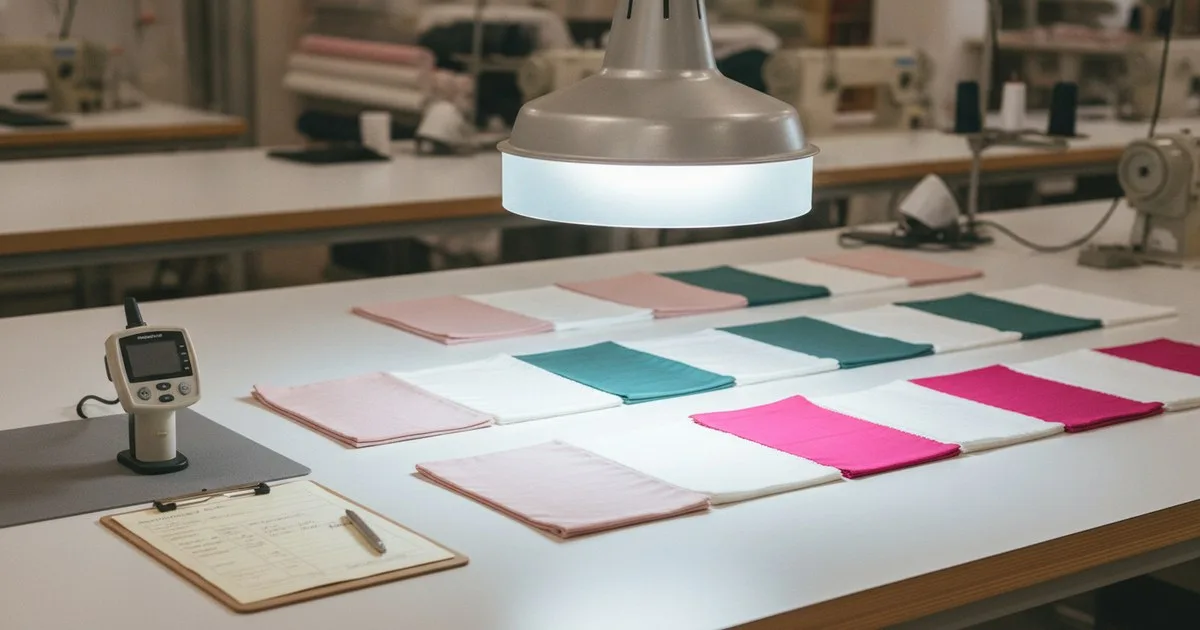
Colour is one of the most common reasons a bulk shipment gets rejected — and one of the most preventable. When the approval chain is clear, documented, and followed at every stage, a colour deviation becomes a correctable event rather than a costly dispute. This guide walks your production team through the full process: setting a colour standard, managing lab dip rounds, running AQL-based bulk inspection, and keeping records that protect everyone.
Key Takeaways
- A colour standard — physical or digital — must be agreed and signed off before the first lab dip is submitted; without it, approval decisions have no objective reference point.
- Lab dip rounds should be capped in your purchase order terms; open-ended revision loops are a leading cause of calendar slippage.
- AQL sampling gives you a statistically defensible pass/fail decision on bulk colour without inspecting every unit.
- Every approval decision — pass, conditional pass, or reject — must be recorded with the date, the assessor's name, and the light source used; verbal sign-offs create disputes.
- PLM platforms such as Centric PLM and WFX centralise colour approval workflows so that the audit trail is automatic rather than assembled after the fact.
What is a colour standard, and why does it come first?
A colour standard is the agreed reference against which every subsequent colour decision is measured. It can be a physical swatch — a dyed fabric strike-off, a Pantone chip, or a sealed master sample — or a spectrophotometric data file (.cxf, .sdf) shared digitally between brand and supplier.
Without a locked standard, lab dip approval becomes subjective. One assessor approves under daylight; another rejects under fluorescent office light. The supplier re-dyes to match what they remember from a video call. These are not edge cases — they are the normal outcome when the standard is undefined.
Before any lab dip is submitted, confirm:
- The colour reference number (Pantone, RAL, or brand-specific code)
- The substrate: the exact fibre content and construction the dye must be assessed on
- The light source(s) for assessment (D65 daylight, TL84 retail, A incandescent — specify all three if metamerism is a concern)
- The tolerance: ΔE value or a descriptive pass/fail band
- Who has authority to give final sign-off on each side (brand QA, merchandiser, factory QC manager)
Record all of this in the colour section of your tech pack. If you are not sure what belongs in a tech pack colour block, our guide to building a complete tech pack covers the field structure in detail.
How does the lab dip approval process work?
A lab dip is a small dyed sample — usually 10–20 cm of fabric — produced by the mill or dye house before bulk dyeing begins. Its purpose is to confirm that the supplier can hit the agreed colour on the agreed substrate before committing to full yardage.
Round structure
Round 1. The supplier submits lab dips — typically two or three shade variations bracketing the standard — alongside a completed lab dip submission form that records the dye recipe, substrate lot, and assessment conditions.
Assessment. Your QA team (or a nominated third-party lab) assesses the dips against the standard under the agreed light sources. Record the ΔE reading if you have a spectrophotometer, or a written descriptor (e.g., "2% too red under D65, acceptable under TL84") if you are assessing visually. Note the light source, the assessor's name, and the date.
Decision. Issue one of three outcomes:
- Approved — proceed to bulk dyeing
- Approved with comment — proceed but address a minor issue (e.g., slight handle difference) before bulk
- Rejected — resubmit; include specific corrective direction ("reduce red component, increase depth")
Subsequent rounds. Each rejection triggers a new round. Cap rounds in your PO terms — three is a common industry limit. If approval is not reached by round three, escalate: either the standard needs revisiting, the substrate is incompatible with the dye class, or the supplier needs technical support.
What goes wrong here
- Metamerism. A dip that matches under D65 shifts under TL84. Specify all relevant light sources upfront and assess under each.
- Substrate drift. The lab dip was assessed on a different fabric lot than the bulk. Always record the fabric lot number on the submission form.
- Verbal approvals. A WhatsApp message saying "looks fine" is not an approval record. Use a form — even a simple PDF — that captures the decision, the assessor, and the date.
- No corrective direction on rejection. "Rejected — please resubmit" without guidance wastes a round. Be specific.
What is AQL, and how does it apply to colour in bulk?
Acceptance Quality Limit (AQL) is the maximum percentage of defective units considered acceptable in a production lot. According to the ANSI Blog (February 2026), AQL is primarily used by QC inspectors, manufacturers, buyers, and importers to determine the maximum allowable defective items in a production batch — for example, an AQL of 1.0 means no more than one defective unit per hundred is tolerable before the lot is rejected.
For colour, AQL inspection at bulk stage is not a substitute for lab dip approval — it is the final gate. By the time bulk fabric or garments reach AQL inspection, the colour should already be confirmed. AQL catches production drift: shade variation between dye lots, uneven dyeing within a roll, or a batch that was dyed against the wrong standard.
Setting your AQL level for colour
Colour is typically classified as a major defect — a defect that would cause a consumer to reject the product or that affects the product's intended use. Major defects are commonly inspected at AQL 2.5, meaning the lot fails if more than 2.5% of sampled units carry the defect. Some buyers tighten this to AQL 1.0 for colour-critical categories (e.g., white or colour-blocked styles where deviation is immediately visible).
The CBI's guidance on organising apparel exports reinforces this: agree the AQL level with your buyer before production begins, and confirm that every approval — fabric, trims, samples — is documented before you ship.
Running a bulk colour inspection
- Pull a random sample from across the production lot using the sample size table for your agreed AQL level and lot size (ISO 2859-1 / ANSI/ASQ Z1.4 tables are the standard reference).
- Assess each unit against the approved lab dip or sealed master sample, under the agreed light source.
- Record each defect — shade too light, shade too dark, uneven dyeing, wrong colour entirely — and classify it (major/minor).
- Count defects against the acceptance number for your AQL level. If defects exceed the acceptance number, the lot fails.
- Document the outcome: lot number, sample size, number of defects found, pass/fail decision, inspector name, date, and light source.
What to do when bulk fails
A failed bulk colour inspection does not automatically mean re-dyeing the entire lot. Your options depend on the severity and scope:
- Sorting: if the defect is confined to specific rolls or panels, sort and quarantine the affected units. Re-inspect the remainder.
- Re-dyeing: viable for some fibre types; assess whether the re-dye will affect handle or dimensional stability.
- Negotiated concession: if the deviation is minor and the buyer agrees, document a formal concession — in writing, signed by both parties — before shipment. Never ship without written buyer sign-off on a deviation.
- Rejection: if the lot cannot be corrected within the delivery window, issue a formal rejection notice and begin root-cause analysis with the supplier.
How do you document colour decisions so they are traceable?
Documentation is where most production teams cut corners and later pay for it. A colour dispute six months after delivery is almost impossible to resolve without records. Here is the minimum you need:
Per lab dip round
- Lab dip submission form (supplier-completed): colour reference, dye recipe reference, substrate lot, submission date
- Assessment record (brand/QA-completed): light source(s) used, ΔE or visual descriptor, decision, assessor name, date
- Physical sample retained and labelled (round number, colour reference, decision)
Per bulk inspection
- Inspection report: lot number, PO number, sample size, defects found by type, pass/fail decision, inspector, date, light source
- Photos of defective units (close-up, with the approved standard in frame for comparison)
- Any concession letters, signed by both parties
Where to keep it
Spreadsheets and email threads work at low volume but break down fast. PLM platforms are built for exactly this: Centric PLM's colour management module lets you attach lab dip submissions, track approval rounds, and log bulk inspection outcomes against the relevant style and colourway — so the audit trail is part of the product record, not a separate filing exercise. WFX similarly centralises supplier communication and approval workflows, which is useful when you are managing multiple factories across different time zones.
Whatever system you use, the record must be searchable by style, colourway, and supplier. When a buyer queries a colour three seasons later, you need to find the answer in under five minutes.
What is still unsolved in colour approval?
The process described above is mature and well-understood. What remains genuinely difficult:
Digital-to-physical translation. Spectrophotometric data files reduce subjectivity, but the translation from a screen colour to a dyed physical substrate still depends on the supplier's dye chemistry, the fibre's affinity, and the finishing process. Digital standards narrow the gap; they do not close it.
Multi-supplier colour consistency. When the same colourway is produced across two or more factories — common in large programmes — achieving visual consistency between lots is harder than achieving compliance with the standard at each factory individually. Metamerism between factories is a real risk.
Late-stage changes. A colour standard changed after lab dip approval — because the buyer's creative team updated the palette — resets the clock. Production teams need a formal change-control process that triggers a new approval chain, not just a revised swatch dropped into a shared folder.
Speed pressure. Compressed calendars push teams to approve on round one even when the dip is marginal. Build explicit hold points into your critical path: no bulk dyeing without written lab dip approval, no shipment without written bulk sign-off. These are not bureaucratic steps — they are the only thing that makes a colour dispute resolvable.
FAQ
How many lab dip rounds is normal before approval? One to three rounds is typical. If you reach round three without approval, escalate rather than continuing — either the standard, the substrate, or the supplier's capability needs to be addressed.
What AQL level should I use for colour defects? Most buyers classify colour as a major defect and inspect at AQL 2.5. Colour-critical styles (white, colour-blocked, or fashion-forward palettes) are often tightened to AQL 1.0. Agree the level in your PO terms before production starts.
Can I approve a lab dip by photo or video call? No. Photos and video calls are useful for communication, but colour assessment requires physical samples under controlled light sources. Use them to discuss direction; use physical samples and a formal record for the actual decision.
What light source should I use for colour assessment? D65 (simulated daylight) is the most common standard for apparel. Add TL84 (retail fluorescent) if the product will be sold in-store under that light, and check for metamerism — a colour that matches under one source but shifts under another.
What happens if bulk colour fails and the delivery date is fixed? Your options are sorting, re-dyeing (if feasible for the fibre), or a negotiated written concession from the buyer. Never ship a failed lot without written buyer sign-off — verbal agreement is not protection if the goods are later disputed.
How do PLM tools help with colour approval documentation? Platforms such as Centric PLM and WFX attach lab dip submissions, approval decisions, and inspection reports directly to the style record. This makes the audit trail searchable by style, colourway, and supplier — far more reliable than email threads or shared drives when a dispute arises months later.
Further Reading
- ISO 2859-1:2026 — Sampling for Inspection by AQL (ANSI Blog)
- 10 Tips for Organising Your Apparel Exports to Europe (CBI)
- What Is a Tech Pack? The Complete Fashion Guide (Techpacker)